ANNUAL ADVERTISING RATES FOR INSURE-DIGEST

Annual Advertisement Rates
Showing posts with label referendum. Show all posts

Saturday, August 31, 2019

Scotland: Nicola Sturgeon: Parliament suspension may make Scottish independence 'inevitable'


The Scottish First Minister claimed that support for leaving the UK was growing with each passing day, accusing the Prime Minister of acting like “some kind of tinpot dictator”.

She also said the suspension proved Mr Johnson would be willing to shut down the Scottish Parliament to achieve his political aims, a suggestion she had previously regarded as “silly”.

But the Scottish Conservatives backed the move, arguing there would still be “ample” time for MPs to debate Brexit and describing the SNP‘s reaction as “predictably hysterical”.

Read more: Nicola Sturgeon: Parliament suspension may make Scottish independence 'inevitable'

Support EU-Digest, which has reported the news without any political affiliation since 2004. by investing in an advertisement, or by giving a donation to keep our efforts going : click on https://www.paypal.com/webapps/hermes?token=8BP18304C1657151J&useraction=commit&mfid=1567106786154_8591ae1288ebf   

Monday, September 3, 2018

Britain - Brexit: Theresa May should start reading the Tea Leaves as 2.6 million Leave voters have abandoned support for Brexit since referendum, major new study finds - by Benjamin Kentish

The Brexit disaster
More than 2.6 million people have abandoned their support for Brexit and now back staying in the EU, a major study has concluded.

If the huge number of Britons who have changed their mind had voted to stay in the EU in 2016, the referendum would have delivered a clear Remain verdict.

The data will add to the debate about whether the country now needs a new referendum, with millions having second thoughts about their Leave vote amid growing fears about Britain crashing out of the EU without a deal.

In a key finding that will particularly intensify pressure on Jeremy Corbyn to take a tougher stance against Brexit, the study found the overwhelming majority of those changing minds are Labour voters in seats the party currently holds.

It comes as Conservative divisions over Brexit deepened, with Theresa May attempting to slap down Boris Johnson after he wrote another article attacking her approach.

The Independent has launched its own campaign for a Final Say referendum, with almost three quarters of a million people having signed our petition demanding one so far.

Read more: 2.6 million Leave voters have abandoned support for Brexit since referendum, major new study finds | The Independent

Saturday, October 28, 2017

Spain: Catalonia: Not one country in the world has so-far recognized Catalonia's declaration of independence

Carles Puigdemont: "to be or not to be?"
Spain’s Senate on Friday voted to grant Madrid powers to impose direct rule on Catalonia, shortly after the semi-autonomous region’s parliament approved a motion declaring independence
.
Herewith are five questions about what it means to make a unilateral declaration of independence:

Known by its acronym UDI, the term was first coined in 1965 when the former Rhodesia’s minority white government declared unilateral independence from British colonial rule.

The process itself is when a new state is established within an existing country, declaring itself sovereign and independent without the consent of the entity, country or state from which it is seceding.

“Any entity has the right to declare its independence. But to become a state that of course requires a territory, a population and authorities,” said Jean-Claude Piris, a Brussels-based international law consultant and former EU legal services director for 23 years.

“But what matters most is recognition by the international community,” he said. “Everyone has the right to issue a declaration of independence, but that in itself has no international consequence.”

Piris said very few countries will recognize Catalonia and “I guarantee you no one will recognize them” in the EU.

“Therefore it will remain an empty declaration: Catalonia will not be represented in international organizations, they will not sit in the EU, they will not be able to do anything and legally they will remain part of Spain,” he said.

Is Catalonia’s UDI legal and what will happen next: -

“What matters now is what will happen nationally and in the streets,” said Piris.

“Are there going to be demonstrations, barricades? Will people accept and submit” if Spain triggers Catalan guardianship . . . “or will there be violence?”

Spain “experienced a civil war not so long ago and just before World War II,” Piris pointed out.

If Catalonia becomes an independent state the implications “cannot be underestimated” said Narin Idriz, a researcher at the Hague-based Asser Institute
.
“All European Union member states cherish their territorial integrity, they will not want the same thing to happen to them, therefore it will be very difficult to find any support,” she said.

Bottom-line: at this point deposed Catalan leader Mr. Carles Puigdemont declaration of independence is not recognized by any country, and he personally risks arrest if he continues to defy the Spanish Constitution.

EU-Digest

Thursday, October 26, 2017

Spain: Catalonia braces for Spain takeover as two sides remain deadlocked - by M. Fiske and L.King

In a crowd outside Catalonia's ornate regional headquarters in Barcelona, two men argued fervently. One was for independence from Spain, the other against.

Like others elsewhere in Catalonia, Xaui Nicolau, 41, and Juan Antonio Martinez, 67, argued over whether the northeastern region's president, Carles Puigdemont, had miscalculated by refusing to renounce secessionist aims.

Puigdemont, in a speech Thursday, ruled out early parliamentary elections — some observers thought holding the elections might help stave off Madrid's takeover — but not independence.

Now, with the Spanish government poised to strip Catalonia of its regional autonomy and remove Puigdemont as soon as Saturday, Nicolau said a unilateral declaration of independence was "the only option" remaining.

But Martinez, like officials in Madrid, staunchly insisted that Catalonia's independence drive was illegal. "It's the way you did it," he said. "It's not constitutional." Spain's Senate is to vote Friday on implementing direct rule in Catalonia to quell its independence bid — a step never before taken in Spain's democratic era by the central government.

After Puigdemont spoke, the regional parliament convened to try to plot a course in the face of Spain's looming deadline. The talk continued into the night before recessing until Friday morning.

Read more: - Catalonia braces for Spain takeover as two sides remain deadlocked – L

Tuesday, October 10, 2017

Spain:Unity Survives, as Catalan local government suspends declaration of independence

Catalan president, Carles Puigdemont 
suspends declaration of independence
The Catalan president, Carles Puigdemont, has pulled the region back from the brink of an unprecedented showdown with the Spanish government by announcing that he will suspend a declaration of independence to pursue negotiations in the hope of resolving Spain’s worst political crisis for 40 years.

Addressing the Catalan parliament on Tuesday evening, Puigdemont said that while the recent referendum had given his government a mandate to create an independent republic, he would not immediately declare unilateral independence from Spain.

“We propose the suspension of the effects of the declaration of independence for a few weeks, to open a period of dialogue,” he said.

“If everyone acts responsibly the conflict can be resolved in a calm and agreed manner.”

Hours before the announcement, Donald Tusk, the president of the European Council, had appealed to Puigdemont to step back from a unilateral declaration of independence and begin dialogue with the Spanish prime minister, Mariano Rajoy.

Rajoy has shown himself willing to take the drastic step of invoking article 155 of the Spanish constitution, which allows the central government to take control of an autonomous region if it “does not fulfill the obligations imposed upon it by the constitution or other laws, or acts in a way that is seriously prejudicial to the general interest of Spain”.

The Spanish prime minister has repeatedly pointed out that the referendum and the laws underpinning it are a violation of the Spanish constitution, which is based “on the indissoluble unity of the Spanish nation, the common and indivisible homeland of all Spaniards”.

His government insists the Catalan question is an internal Spanish matter, and has promised to use all the legal and constitutional means at its disposal to try to stop the regional government’s manoeuvres. It has also deployed thousands of Guardia Civil and national police officers to Catalonia.

Note EU-Digest: Some background on Catalonia and their quest for independence: 


Catalonia has a total population of 7.5 million people. 

On the October 1, polling results, reported by the Catalan government, from the illegally declared referendum by the Spanish government -  it showed the "Yes" side had "won", with 2,044,038 (92.01%) voting for independence and 177,547 (7.99%) voting against, on a turnout of only 43.03% of the eligible voters.

Even though the referendum was held, it must be noted that based on Catalan law, the referendum should not have been held  re: Catalan Statutes of Autonomy - which states that a two third majority is required in the Catalan parliament, before any changes to the Catalonia's Political status can be made.

There was no 2/3 majority, when the vote was held in the Catalan parliament, to approve the holding of a referendum.  It was, however, decided by the ruling parties in the Catalan parliament that a simple majority vote in the Catalan parliament would be sufficient to hold the referendum  

In addition, the holding of the referendum itself, was also declared illegal, based on the Statutes of the Spanish Constitution.  Consequently the holding of a Catalan referendum was also suspended by the "Constitutional Court of Spain" on 7 September 2017. 

Nevertheless, Mr. Carlos Puigdemont still went ahead with the referendum.

Bottom-line the Catalan government, and its President Carles Puigdemont broke every Spanish law there was to break. 

Mr. Puigdemont and several of his cohorts can consider themselves very lucky not to have already been arrested and prosecuted. It could, however, still happen, if they continue to pursue this absurd nationalistic goal. 

EU-Digest

Monday, October 2, 2017

Spain: Catalan Government announces results of illegal referendum: figures nebulous and not substantiated


The Catalan government said around 2.26million people voted in the banned independence referendum to leave Spain on Sunday, representing a turnout of around 42.3 percent of Catalonia's 5.34million voters.

Throughout history plebiscites have often been tools for dictators to force voters to give up their freedoms while keeping up an appearance of having the nation’s support

This one in Catalonia was not any different, but adding to the controversy was also the fact that like in previous Catalan referendums less than 50 % of the Catalan voters turned out.

As to claims of police brutality, all fingers should be pointing to the Catalan government, which despite the fact that the Supreme court of Spain and the Spanish government ruled the referendum was illegal, the local Catalan government still went ahead with the referendum.

EU-Digest   

Sunday, April 16, 2017

Turkey votes to expand president’s powers wih minimal margin; critics cry fraud - by E. Becatoros, S. Fraser and Z.Bilginsoy

Turkey Referendum :Erdogan 's intimidation worked  barely
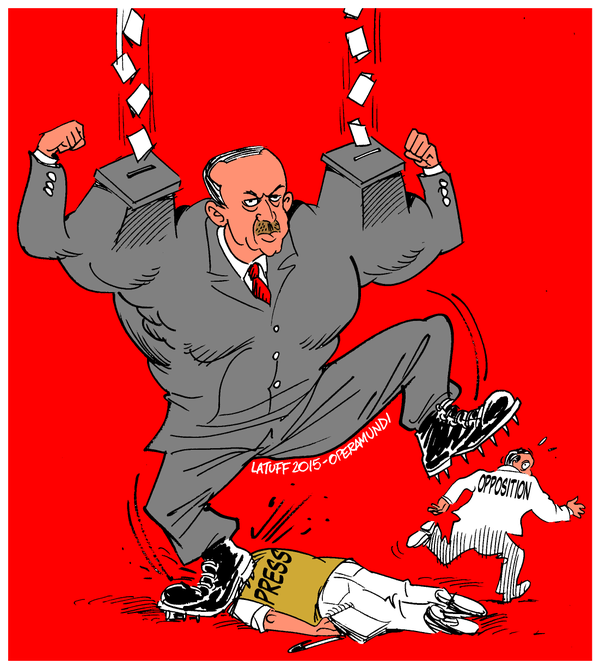
Turkish President Recep Tayyip Erdogan won a historic referendum Sunday that will greatly expand the powers of his office, although opposition parties questioned the outcome and said they would challenge the results.

With 99 percent of the ballots counted, the “yes” vote stood at 51.37 percent, while the “no” vote was 48.63 percent, according to the state-run Anadolu Agency. The head of Turkey’s electoral board confirmed the “yes” victory and said final results will be declared in 11-12 days.

Although the margin fell short of the sweeping victory Erdogan had sought in the landmark referendum, it could nevertheless cement his hold on power in Turkey and is expected to have a huge effect on the country’s long-term political future and its international relations.

The 18 constitutional amendments that will come into effect after the next election, scheduled for 2019, will abolish the office of the prime minister and hand sweeping executive powers to the president.

In his first remarks from Istanbul, Erdogan struck a conciliatory tone, thanking all voters no matter how they cast their ballots and calling the referendum a “historic decision.”

“April 16 is the victory of all who said ‘yes’ or ‘no,’ of the whole 80 million, of the whole of Turkey,” Erdogan told reporters in address that was televised live.

But he quickly reverted to a more abrasive style when addressing thousands of flag-waving supporters in Istanbul

“There are those who are belittling the result. They shouldn’t try, it will be in vain,” he said. “It’s too late now.”

Responding to chants from the crowd to reinstate the death penalty, Erdogan said he would take up the issue with the country’s political leaders, adding that the question could be put to another referendum if the political leaders could not agree.

Note EU-Digest: Given the result of the referendum and charges of intimidation, in addition to the possibility of electoral fraud, President Erdogan, in all reality, can not really claim he got a sweeping mandate to change the Turkish Constitution in this referendum

The fears of electoral fraud and government meddling is now more relevant than ever, fueled by the extraordinary powers the government wields under the state of emergency. 

The badly crippled Peoples’ Democratic Party (HDP), the main Kurdish political force, which has been trying to soldier on with its “no” campaign against its main rival, the ruling Justice and Development Party (AKP) has also voiced their concerns.

HDP members say they have been facing the “unchecked power” of the government, reflected not only in obstructions to their campaigns, but also in moves to keep party activists away from polling stations today, March 16.

Read more: Turkey votes to expand president’s powers; critics cry fraud - The Washington Post

Saturday, April 15, 2017

Turkey-EU ties: a bargaining chip on eve of referendum

Turkey’s president Tayyip Erdogan has ramped up his anti-EU rhetoric on the eve of a referendum which would hand him sweeping powers.

Erdogan said he would review Ankara’s relationship with Brussels, as he seeks to shore up support for the constitutional changes needed to transfer more power away from parliament to the president.

Turkey’s president Tayyip Erdogan has ramped up his anti-EU rhetoric on the eve of a referendum which would hand him sweeping powers.

Erdogan said he would review Ankara’s relationship with Brussels, as he seeks to shore up support for the constitutional changes needed to transfer more power away from parliament to the president.

“The EU has lost all credibility. We don’t defend democracy, human rights and freedoms because they want us to, we do that because our citizens deserve it. As we get closer to democracy, they are moving away from it,” Erdogan told supporters at a rally in Istanbul.

He continued saying that the EU feared the new system because Turkey would be ‘even stronger’. In his speech he said that the EU had left Turkey waiting 54 years for membership, and that the vote on Sunday would be a turning point.

Over the course of the campaign Erdogan’s speeches have shown a clear shift in ties with Brussels, becoming far more critical of the 27-member bloc. When ministers attempted to campaign in EU countries, there was a clampdown on rallies and Erdogan responded by calling leaders ‘fascists’ and ‘Nazis’.

Also in Istanbul, the ‘No’ campaign formed a symbolic human chain on the European side of the Bosphorous strait which divides Asia and Europe.

They fear the constitutional changes would see Turkey lurch towards authoritarianism. The new system could allow Erdogan to run for two more terms, potentially stretching his rule to 2029.

“I have two children. I’m here for my children and for a Turkey where the values I was born with remain, where my children can continue to think freely and where journalists and teachers are not put behind bars,” said one ‘No’ supporter.

The vote comes at a time of turmoil, with the country reeling from a series of bombings by ISIL and Kurdish militants, a failed coup and subsequent purge as well as a deep economic slowdown, something which the president says requires a stronger leadership to bring under control.

Turkey-EU ties: a bargaining chip on eve of referendum | Euronews

Wednesday, April 12, 2017

Turkish Referendum - "Erdogan's Turkey" - by Mark Lowen EU-Digest

Referendum: Is Turkey moving
towards a legalized dictatorship 
A BBC special report on Turkey notes:  "Some guests were awoken by the gunshots, others by the buzzing of three Black Hawk helicopters"

It was the early hours of 16 July 2016. Around two-dozen Turkish commandos dropped into the grounds of the luxury Club Turban hotel in the coastal resort of Marmaris, armed with automatic rifles and grenades.

They were hunting one man - Recep Tayyip Erdogan. The president had been holidaying at a private villa linked to the hotel. Commandos had been sent to capture the president. It should have been the climax of their coup d'etat. Opening fire and hurling grenades, they stormed the hotel, killing two bodyguards. But they were too late.

 Acting on a tip-off, Erdogan had been whisked away from the resort by helicopter. Once at Dalaman Airport, he took a private jet to Istanbul, with his pilot masking its identity so it appeared on radars as a normal civilian passenger plane.

After 03:00, the president emerged outside Istanbul's Ataturk Airport to the roars of his supporters.

The coup attempt had failed - and Recep Tayyip Erdogan was to emerge stronger than ever.

Erdogan went from almost losing control of his country to becoming untouchable.

But for Turkey's most powerful leader since its founding father, Mustafa Kemal Ataturk, it wasn't enough. After 11 years as prime minister, Erdogan had been elected president in 2014.

The post was traditionally largely ceremonial but Erdogan had other ideas.

The dominant figure in Turkish politics had long dreamed of enshrining his authority through constitutional change, turning Turkey from a parliamentary to a presidential republic, scrapping the post of prime minister and consolidating his hold on the country.

This previously stable corner of the region has become consumed by terror attacks - once-rapid economic growth has stalled.

Dozens of journalists are in jail. Three million, mostly Syrian, refugees have poured into the country.

Tens of thousands of people have been arrested or dismissed following the failed coup. The country's hope of EU membership is evaporating. And Turkey is arguably more politically polarized than ever.

But at the same time, Turkey has gone from a financial basket-case at the turn of the century into one of the world's top 20 economies.

The middle-class has hugely expanded. Millions of impoverished Turks have been economically emboldened under Erdogan's leadership.

And now, on April 16 the country will vote on its future in a referendum  which: proposes:

*Prime minster role scrapped, new vice president role created
*President becomes head of government as well as state, and can retain political party ties
*President given sweeping powers, with ability to enact laws by decree and dismiss parliament
*Parliament no longer able to scrutinise ministers
*Parliament given limited powers to investigate or impeach president

Basically if this referendum passes on the terms as listed above it will turn Turkey into a democratically legalized dictatorship.

Sunday, April 2, 2017

Turkish Referendum: Turkish citizens living abroad have started voting at their Embassies and Consulates - by RM

Voting referendum has started

Large numbers of Turks all over the world have started going to the polls since March 27 to vote yes or no on a new Turkish Constitution,

The referendum which President Recep Tayyip Erdoğan is currently putting to vote around the world and in Turkey on April 16 will bring about a complete overhaul in the Turkish system of governance.

The change will abolish the office of the prime minister and concentrate dictatorial power in the president’s hands.

If the referendum is successful, Erdoğan could stay on as president not only for two terms, until 2029, but also uncontested.

Unfortunately, all opposition is just about wiped out, due to the systematic crackdown against any dissent in Turkey by President Erdogan.

Turks in Turkey today seem reluctant to protest this anti-democratic (Referendum) move.

In Turkey itself the Pew Research Center finds that on a number of issues, Turks are almost evenly split between those who are happy with Erdogan’s leadership and the state of the nation, and those who believe the former Istanbul mayor is leading the country down the wrong path. Overall, 44% are satisfied with the country’s direction, while 51% are dissatisfied. Half say the economy is doing well, while 46% think it is in bad shape. Forty-eight percent say Erdogan is having a good influence on the country, while  the same percentage believes he is having a negative impact.

Young and old taking voting rights very serious
There are some 7 million Turks living outside Turkey, of which close to 5 million live in Europe, approximately half a million in the US, and about 44.000 in Canada. The rest are scattered  around the world

Given early exit polls, verified by EU-Digest, the yes vote in Europe is ahead by about 2 % , while in the US and Canada, which both have a larger number of higher educated and economically more prosperous Turks than in Europe, the no vote is ahead by close to 35 %

With Democracy seemingly  on the way out in Turkey it is remarkable, that when U.S. Secretary of State Rex Tillerson visited Turkey last week he failed to raise concerns that the country may be sliding toward a dictatorship and made no mention at all of mass arrests of protesters and the purge of opponents that followed last year’s failed coup attempt, or the crackdown on the news media.  Turkey now has more than half of the world’s journalists in jail.

Turkey is also  internally at war with the Kurds, which make up close to a quarter of its population,

As of today the Erdogan Government has dismissed over 130,000 people from their jobs and filled the prisons with them. Also some 6,300 academics were fired from their jobs, while fifteen universities were  closed.

Bottom-line, a win for NO in the referendum is probably the last chance for Turkey to reestablish a more positive image of the country abroad and the fact that Democracy there is not totally dead.  

EU-Digest

Wednesday, March 8, 2017

Turkey has stepped up spying in Germany, says Berlin

Erdogan Dictatorship Referendum
Turkey has stepped up spying in Germany, says Berlin

Amid ongoing diplomatic unrest, German intelligence has reported an increase in Turkish spying in Germany. Turkey's Foreign Minister meanwhile has said Berlin "must decide whether Germany is a friend or not."

Read more: Symbolbild NSU Affäre Verfassungsschutz Jahrestag Terrorismus Rechtsradikale (picture-alliance/dpa)   

While tensions between Berlin and Ankara have escalated ahead of next month's referendum on Turkey's presidency, the German government said on Wednesday that there has been a significant increase in Turkish spying in Germany.

Germany's domestic intelligence agency, the BfV, said divisions in Turkey leading up to the controversial April 16 referendum on boosting the powers of President Recep Tayyip Erdogan were mirrored in Germany.

"The BfV is observing a significant increase in intelligence efforts by Turkey in Germany," it said in a statement. No further details were provided.

Already strained relations between Germany and Turkey reached a new low this month in a row over canceled Turkish political rallies to drum up support for the impending referendum.

Some 1.4 million Turks living in Germany are eligible to cast their ballot in the vote.

Hoping to calm the storm on Wednesday, German Foreign Minister Sigmar Gabriel met with his Turkish counterpart Melvut Cavusoglu in Berlin. While both diplomats agreed on the importance of good relations, Cavusoglu said that Germany must now "decide whether Turkey is a friend or not."

In light of recent comments from both Cavusoglu and Erdogan, Gabriel also made it clear that in maintaining good relations "there are lines that should not be crossed."

"...And one of those is the comparison with Nazi Germany," Gabriel said.

Cavusoglu, meanwhile, said he would host Gabriel for a new round of talks in Turkey "as soon as possible."

In a bid to secure support ahead of next month's referendum, Erdogan himself is also due to hold a rally in Germany. Critics have warned, however that the proposed presidential system which seeks to expand Erdogan's powers as president would cement a one-man rule in the country.

Read more: Turkey has stepped up spying in Germany, says Berlin | News | DW.COM | 08.03.2017

Sunday, March 5, 2017

Germany - Turkey Relations: Turkey's Erdogan makes Nazi jibe over Germany rally ban

Recep Tayip Erdogan
Turkey's president has compared German officials to Nazis, in the latest escalation in a war of words.

Recep Tayyip Erdogan hit out after German authorities cancelled rallies designed to woo ethnic Turkish voters in Germany ahead of a key referendum.

"Your practices are not different from the Nazi practices of the past," Mr Erdogan said.

German Justice Minister Heiko Maas said the comments were "absurd, disgraceful and outlandish".

About 1.4m Turks in Germany can vote in the April referendum, which could give Mr Erdogan sweeping new powers.

Voters will be asked whether they back a new constitution, which would transform the country from a parliamentary republic into a presidential one.

That would give Mr Erdogan, as president, new powers over the budget and the appointment of ministers and judges, as well as the power to dismiss parliament.

Note EU-Digest: Look who is calling the kettle black - Take note President Erdogan - Europe says with one voice NO NO NO to your intimidation and accusations and.hopes Turkey's population will do the same.during the upcoming referendum by also saying No, No, No.. 

This is.not about Islam or any religion but in favor of democracy and against out of.control politicians like Erdogan, Le Pen. Wilders and.others.

Read more: Turkey's Erdogan makes Nazi jibe over Germany rally ban - BBC News

Sunday, November 27, 2016

Italy: The Italian referendum and what else to look out for in the economy this week

Is everyone too gloomy about the world economy, and indeed the British one too? After a tumultuous week, with the US coming to terms with a shift in economic policy (and much more) and the UK counting the potential cost of Brexit, this should be a week for reflection. Second thoughts are usually better than first ones.

As far as the UK is concerned, the most interesting thing to look for will be how the economic forecasts for 2017 are shaping up. The official view, that of both the Bank of England and the Office for Budget Responsibility, is that growth will be around 1.4 per cent. The OBR took some stick for that last week, unfairly because the whole point of having an independent office is that it should be independent of political pressure, and it was doing just that. In any case that forecast was at the top end of the present expected scale.

The question now is whether other forecasters will start to revise their forecasts upwards, given the loosening of policy in the US (which should, in the short term, boost growth there). At the margin that should benefit the UK. A bigger influence, however, will be a more general rethinking of the behaviour of UK consumers, which have kept the economy growing solidly though the second half of this year. If they keep going next year, maybe growth forecasts should be revised up for 2017, just as they have for 2016. We should start to see the new private sector forecasts for 2017 starting to come through in the next few days.

Next, there are some purchasing managers’ indices or PMIs, coming out this week. These, you will remember, give an indication of the optimism/pessimism of the business community and hence of future growth. On Thursday we get the UK ones for manufacturing and on Friday for construction. We have to wait until the following Monday for the all-important services sector. Expect a gradual, cautious recovery. But – more important – on Thursday we get world-wide PMIs for manufacturing. That will tell us about the world, which is of course matters vastly more. Global recession next year? Not if global PMIs remain positive.

The Italian referendum and what else to look out for in the economy this week | The Independent

Monday, October 3, 2016

Hungary PM claims EU migrant quota referendum victory - but is it a victory ?

Hungarian PM Viktor Orban has declared victory in a referendum on mandatory EU migrant quotas, despite a low turnout that appeared to render it invalid.

Nearly 98% of those who took part supported the government's call to reject the EU plan.

But only 43% of the electorate voted, short of the 50% required to be valid.

Note EU-Digest: The Hungarian referendum was declared void and illegal because voter participation was 43 %, well below the allowed 50 % threshold and in reality a vote of no- confidence for the PM because the opposition had told their supporters to abstain from voting.

Read more: Hungary PM claims EU migrant quota referendum victory - BBC News

Friday, June 24, 2016

Scotland seeks independence: Nicola Sturgeon: second Scottish independence poll highly likely - by Severin Carrell Libby Brooksand

Scotland is on the brink of staging a fresh referendum on independence after Nicola Sturgeon requested talks with the EU on separate membership after the UK’s vote to leave.

The first minister said she believed a second referendum on independence was highly likely after Scotland voted overwhelmingly to remain within the EU, but was unable to prevent the leave campaign winning by 52% to 48% across the UK as a whole.

Sturgeon said that was a “democratic outrage” and constituted the clear, material change in Scotland’s circumstances referred to in the Scottish National party’s carefully worded manifesto commitment in May to hold a second independence vote if needed.

“It is a significant material change in circumstances. It’s a statement of the obvious that the option of a second independence referendum must be on the table, and it is on the table,” she said.

Sturgeon announced that she was instructing Scottish government officials to draft fresh referendum legislation for Holyrood, only two years after her party lost the first independence vote in 2014, to ensure it could be held quickly if enough Scottish voters backed it.

UK government sources said David Cameron, who quit as prime minister after the referendum defeat, was anxious that his successor make sure the Scottish, Welsh and Northern Ireland government were closely involved in the UK’s Brexit negotiations to avoid increasing Scottish grievances and fuelling the case for independence.

Sturgeon’s cabinet will meet in emergency session on Saturday morning at her official residence Bute House, and is expected to agree plans to put forward referendum legislation in September’s programme for government.

Read more: Nicola Sturgeon: second Scottish independence poll highly likely | Politics | The Guardian

Monday, May 16, 2016

Half of Europeans think Britain will leave the EU "but poll shows all of them think their country should stay in" – by Vince Chadwic

BREXIT
Half of Europeans in eight EU countries think Britain will vote to leave in the June 23 referendum, according to a poll published Monday.

The Ipsos MORI survey also found that almost half of those questioned think their country should follow Britain’s lead and hold a referendum on EU membership.

The online survey of between 500 and 1,000 adults under the age of 65 in eight countries, plus the U.K., found 45 percent want an EU referendum, and 33 percent would vote to leave if given the choice today.

In Italy, 48 percent would vote to leave in a hypothetical referendum, compared to 41 percent in France and 39 percent in Sweden. Only 22 percent of Poles and 21 percent of Spaniards would vote to go.

“A topic that unifies [Poles] to a large degree is our membership of the European Union,” Polish President Andrzej Duda told Polsat news in a recent interview. “There are no serious politicians today who say that we should leave the European Union.”

Do you think your own country should hold an EU referendum?


Blue Yes - Red No
 In the event of an EU referendum in your own country, how would you vote?


Blue Remain: Red: Opt out

SOURCE: Ipsos MORI Brexit poll May 9

Read more: Half of Europeans think Britain will leave the EU – POLITI

Monday, February 15, 2016

Brexit fears stalk currency markets ahead of EU summit - by David Oakley, Elaine Moore and Roger Blitz

To be or not to be
Investors are betting that sterling is heading for another big tumble as currency markets are gripped by Brexit fears.

Net short positions on the pound have increased to the highest level since the summer of 2013, according to data from the US Commodity Futures Trading Commission.High quality global journalism requires investment.

With prime minister David Cameron expected to announce the date for the vote soon, possibly at the EU summit this week, some investors are predicting a rocky ride for sterling in the currency markets in the next few months.

The pound has fallen about 8 per cent since the middle of November on a trade weighted basis, with investors citing the uncertainty surrounding the Brexit vote, which could come as early as June, as one of the main reasons for the weakness in the currency.

“We need to be prepared for a choppy market,” said James Maltin, investment director at wealth manager Rathbones. “The Brexit debate may be about to heat up. It is yet another uncertainty out there that could hit the UK markets.”

Some analysts fear a potential Brexit could spark a recession, with Nomura, the Japanese bank, warning that the pound could fall 10 per cent to 15 per cent if overseas investors prove unwilling to finance Britain’s current account deficit.

Mark Carney, governor of the Bank of England, warned in January that concerns about Britain’s exit from the EU could test “the kindness of strangers” that the country relies on to fund its hefty current account deficit with the rest of the world.

Britain has a relatively large current account deficit of 3.7 per cent of gross domestic product. The worry is that overseas investors, which hold £427bn in UK government bonds, or a quarter of the market, might start to sell, putting further pressure on the pound.

Read more: Brexit fears stalk currency markets ahead of EU summit - FT.com

Thursday, February 4, 2016

Brexit? – The UK’s renegotiation: Keeping up appearances - by Paul De Grauwe

The EU as seen by  Eurosceptics
How far does the UK’s draft renegotiation proposal go in reforming the country’s EU membership?

Paul De Grauwe writes that the deal is largely an exercise in keeping up appearances, with most of the agreed terms making little substantive difference to the UK’s terms of membership. He argues that rather than pretending to have achieved real reform, Cameron should follow a strategy of asserting that remaining a member of the EU, as it is today, will be good for Britain.

Read the complete report : EUROPE – The UK’s renegotiation: Keeping up appearances

Tuesday, November 3, 2015

Britain-EU: 12 reasons why Cameron will lose on Brexit – by Denis MacShane

Commentators on British affairs spend much of their time dwelling on Brexit these days; and while acknowledging the passion and verve of the Out camp, their consensus appears to be that the British are too pragmatic a people to tear down the European status quo. Here’s why the pundits are wrong, and why Britain will vote to leave the European Union in the forthcoming referendum called by Prime Minister David Cameron.

1. British history is different

Britain has not been invaded or occupied, or lost sovereignty to any foreign power, in centuries. When people like Alexander Stubb, Finland’s finance minister, tell the BBC that the EU has brought “peace, prosperity and security and there’s no price tag on that,” such soaring rhetoric may play well in countries that once were taken over by the Nazis or Soviets, but it sounds much too far-fetched and continental for the average Brit.

2. No-growth eurozone

Britain was pro-European from the 1950s to the 1980s when continental Europe had growth rates double or triple those of the U.K. Since the launch of the euro, however, the EU has been the slow coach of the global economy, comfortable but out-performed by North America and the BRICs, with all the exciting economic energy coming from Silicon Valley, Singapore, Apple, Samsung, and anything made-in-China. U.S. universities add economic value. European universities give us cause for philosophical introspection.

3. Britain’s off-shore media owners

Britain is unique in allowing its major newspapers to be owned by men who pay no tax in Britain and who dislike the EU. That’s their right, but as a result, the news coverage of Europe over 25 years has been skewed to crude misreporting and propaganda. Even the Guardian regularly runs pro-Brexit columns from its stars like Simon Jenkins or Owen Jones, the rising young-left writer. The BBC has turned Nigel Farage into a national hero by giving him unimpeded access to all major political discussion programs.

4. Tony Blair

The former Labour prime minister was pro-European, but he dodged all difficult European decisions. He offered a referendum on joining the euro, which meant the pound would never fold into the single currency. He offered a referendum on the EU constitutional treaty, which forced Jacques Chirac to do the same, and thus, with the help of a divided French Socialist Party, brought European integration to a full stop in 2005. Cameron has copied Blair by offering a referendum on Brexit. At least Blair was smarter. He bought time with referendum pledges but never actually held one.

5. The Tory party

From Churchill’s United States of Europe speech in 1946 through Edward Heath’s joining Europe in 1973 to Margaret Thatcher adopting majority voting and thus sharing sovereignty in the European Single Act of 1985 — initiatives all opposed by Labour — the Conservatives were the European party in Britain. Today, all top Tories proclaim themselves Euroskeptic. It has been impossible to be selected to be a Tory MP without swearing an oath of Euroskepticism to party militants.

6. Pro-EU campaign muddles

A dismissive Napoleon said England was a nation of shopkeepers, so the U.K. has found one: Stuart Rose. He began selling underwear in Marks and Spencer and rose to become Britain’s Number One shopkeeper and thus was seen as a natural choice to head the anti-Brexit campaign. But a few months before he featured as a star in the pro-Brexit “Business for Britain” organization, so the double-messaging is confusing.

7. Money

The Vote Leave campaign is drowning in cash, with £20 million raised already. Rich City types, Mayfair hedgies, online betting billionaires, and others sitting on cash piles who like access to top political personalities have funded endless Euroskeptic campaigns since the 1990s, ranging from Sir James Goldsmith’s Referendum Party to Lord Rodney Leach’s Open Europe think tank. By contrast the Remain or In campaigners are badly underfunded. Under the law on political donations, FTSE 100 firms that oppose Brexit cannot give money to political campaigns without a special shareholders’ meeting which CEOs do not want to call for fear of infiltration by UKIP and other anti-EU fanatics.

8. Brussels and Strasbourg

It’s not their fault, but the bigwigs of Brussels and orators of Strasbourg cut no ice in Britain. They are seen as over-bossy, over-greedy, and over there. Nigel Farage boasted on TV in 2009 that he had collected £2 million in expenses as an MEP, and ever since, MEPs have been seen as being on a rolling gravy train. At every meeting on Brexit someone asks why the U.K. should belong to an organization that cannot even audit its books properly. Most top EU leaders speak fluent “EU-nglish.” It is perfectly understandable. But in a nation that is taught by Shakespeare to mock foreign accents, being told to love Europe by non-natives doesn’t work.

9. Brits can have two votes

The most seductive line from the Out campaigners is that nothing much will change. The ambitious mayor of London, Boris Johnson, constantly tells anyone who will listen that the U.K. will “flourish” outside the EU. Others say that a Brexit vote will have a catalytic impact on a sclerotic EU that will finally accept British demands for reforms which return Europe to its earlier condition of sovereign nation-states. And then when Britain is offered a Europe it likes, a second referendum can take it back in.

10. Business

Employer outfits like the Confederation of British Industry, the British Chambers of Commerce, or the Institute of Directors have produced report after report in recent years criticizing the EU for red tape and supporting dialogue with trade unions. Business has told the prime minister he must get concessions from Brussels to weaken social Europe or special protectionist measures for the City. The sound of the CBI, BCC or IOD on Europe this century has been one long moan. Now they are panicking as they realize that their non-stop complaints about what Cameron calls the “bossy and bureaucratic” EU have been absorbed by their members, who may decide to vote down an outfit that British business has been so hostile to.

11. The liberal Left

It’s not just classic little Englander xenophobes who find fault with Europe. The Labour Party in Scotland last weekend voted to oppose TTIP, and for many of the leftish intelligentsia Europe is a wicked conspiracy to promote globalized capitalism with all power flowing to multinationals at the expense of workers. The Guardian recently gave a page to a leading TV economics reporter, Paul Mason, to denounce the treatment of Greece by Europe. Another totemic veteran of British leftism, Tariq Ali, gravely informed his readers that he would vote Out in Cameron’s plebiscite to show solidarity with the Greeks and their Syriza government. He did not seem to know that in the July referendum and September election, the Greeks voted Yes to Europe and then Yes to staying in the euro — so for British lefties to vote the U.K. out of Europe is solipsistic self-indulgence even by British leftie standards.

12. Europeans

The Brits, over the years, have been shaped by foreigners arriving from persecution or poverty — Protestants from France, Jews from Tsarist Russia and Nazi Germany, Poles and Hungarians from Communist tyranny, peasant laborers from Ireland and black, Muslim and Hindu citizens from the Commonwealth. But the enlargement of the EU to poor east and south-east European nations has seen a massive influx of 3 million new inhabitants in little more than a decade. They work hard, pay taxes, pay rent and fill churches. But for the average Brit, too many have arrived too fast, and so the cry to “regain control of our frontiers” resonates.

Denis MacShane is a former minister of Europe in Tony Blair’s Labour Government. He is the author of “Brexit: How Britain Will Leave Europe” (IB Tauris, 2015) and works as an adviser on European politics and policy in London and Brussels.

Read more: 12 reasons why Cameron will lose on Brexit – POLITICO