ANNUAL ADVERTISING RATES FOR INSURE-DIGEST

Annual Advertisement Rates
Showing posts with label Dictatorship. Show all posts

Saturday, April 15, 2017

Turkey-EU ties: a bargaining chip on eve of referendum

Turkey’s president Tayyip Erdogan has ramped up his anti-EU rhetoric on the eve of a referendum which would hand him sweeping powers.

Erdogan said he would review Ankara’s relationship with Brussels, as he seeks to shore up support for the constitutional changes needed to transfer more power away from parliament to the president.

Turkey’s president Tayyip Erdogan has ramped up his anti-EU rhetoric on the eve of a referendum which would hand him sweeping powers.

Erdogan said he would review Ankara’s relationship with Brussels, as he seeks to shore up support for the constitutional changes needed to transfer more power away from parliament to the president.

“The EU has lost all credibility. We don’t defend democracy, human rights and freedoms because they want us to, we do that because our citizens deserve it. As we get closer to democracy, they are moving away from it,” Erdogan told supporters at a rally in Istanbul.

He continued saying that the EU feared the new system because Turkey would be ‘even stronger’. In his speech he said that the EU had left Turkey waiting 54 years for membership, and that the vote on Sunday would be a turning point.

Over the course of the campaign Erdogan’s speeches have shown a clear shift in ties with Brussels, becoming far more critical of the 27-member bloc. When ministers attempted to campaign in EU countries, there was a clampdown on rallies and Erdogan responded by calling leaders ‘fascists’ and ‘Nazis’.

Also in Istanbul, the ‘No’ campaign formed a symbolic human chain on the European side of the Bosphorous strait which divides Asia and Europe.

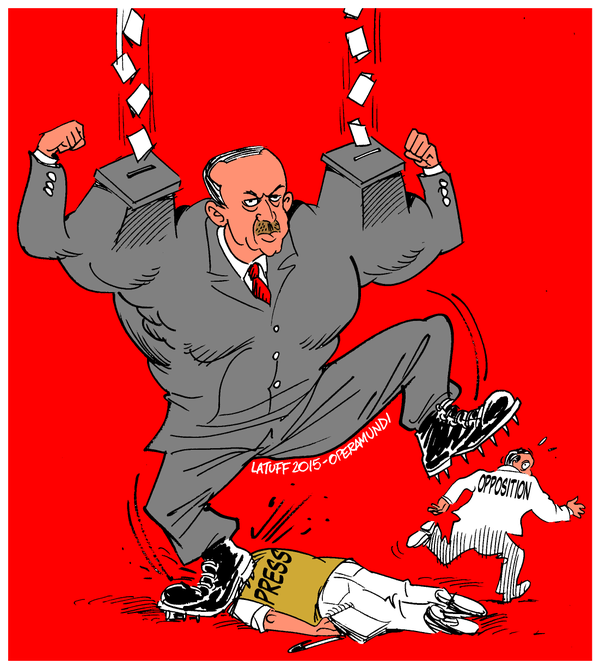
They fear the constitutional changes would see Turkey lurch towards authoritarianism. The new system could allow Erdogan to run for two more terms, potentially stretching his rule to 2029.

“I have two children. I’m here for my children and for a Turkey where the values I was born with remain, where my children can continue to think freely and where journalists and teachers are not put behind bars,” said one ‘No’ supporter.

The vote comes at a time of turmoil, with the country reeling from a series of bombings by ISIL and Kurdish militants, a failed coup and subsequent purge as well as a deep economic slowdown, something which the president says requires a stronger leadership to bring under control.

Turkey-EU ties: a bargaining chip on eve of referendum | Euronews

Wednesday, April 12, 2017

Turkish Referendum - "Erdogan's Turkey" - by Mark Lowen EU-Digest

Referendum: Is Turkey moving
towards a legalized dictatorship 
A BBC special report on Turkey notes:  "Some guests were awoken by the gunshots, others by the buzzing of three Black Hawk helicopters"

It was the early hours of 16 July 2016. Around two-dozen Turkish commandos dropped into the grounds of the luxury Club Turban hotel in the coastal resort of Marmaris, armed with automatic rifles and grenades.

They were hunting one man - Recep Tayyip Erdogan. The president had been holidaying at a private villa linked to the hotel. Commandos had been sent to capture the president. It should have been the climax of their coup d'etat. Opening fire and hurling grenades, they stormed the hotel, killing two bodyguards. But they were too late.

 Acting on a tip-off, Erdogan had been whisked away from the resort by helicopter. Once at Dalaman Airport, he took a private jet to Istanbul, with his pilot masking its identity so it appeared on radars as a normal civilian passenger plane.

After 03:00, the president emerged outside Istanbul's Ataturk Airport to the roars of his supporters.

The coup attempt had failed - and Recep Tayyip Erdogan was to emerge stronger than ever.

Erdogan went from almost losing control of his country to becoming untouchable.

But for Turkey's most powerful leader since its founding father, Mustafa Kemal Ataturk, it wasn't enough. After 11 years as prime minister, Erdogan had been elected president in 2014.

The post was traditionally largely ceremonial but Erdogan had other ideas.

The dominant figure in Turkish politics had long dreamed of enshrining his authority through constitutional change, turning Turkey from a parliamentary to a presidential republic, scrapping the post of prime minister and consolidating his hold on the country.

This previously stable corner of the region has become consumed by terror attacks - once-rapid economic growth has stalled.

Dozens of journalists are in jail. Three million, mostly Syrian, refugees have poured into the country.

Tens of thousands of people have been arrested or dismissed following the failed coup. The country's hope of EU membership is evaporating. And Turkey is arguably more politically polarized than ever.

But at the same time, Turkey has gone from a financial basket-case at the turn of the century into one of the world's top 20 economies.

The middle-class has hugely expanded. Millions of impoverished Turks have been economically emboldened under Erdogan's leadership.

And now, on April 16 the country will vote on its future in a referendum  which: proposes:

*Prime minster role scrapped, new vice president role created
*President becomes head of government as well as state, and can retain political party ties
*President given sweeping powers, with ability to enact laws by decree and dismiss parliament
*Parliament no longer able to scrutinise ministers
*Parliament given limited powers to investigate or impeach president

Basically if this referendum passes on the terms as listed above it will turn Turkey into a democratically legalized dictatorship.

Wednesday, March 8, 2017

Turkey has stepped up spying in Germany, says Berlin

Erdogan Dictatorship Referendum
Turkey has stepped up spying in Germany, says Berlin

Amid ongoing diplomatic unrest, German intelligence has reported an increase in Turkish spying in Germany. Turkey's Foreign Minister meanwhile has said Berlin "must decide whether Germany is a friend or not."

Read more: Symbolbild NSU Affäre Verfassungsschutz Jahrestag Terrorismus Rechtsradikale (picture-alliance/dpa)   

While tensions between Berlin and Ankara have escalated ahead of next month's referendum on Turkey's presidency, the German government said on Wednesday that there has been a significant increase in Turkish spying in Germany.

Germany's domestic intelligence agency, the BfV, said divisions in Turkey leading up to the controversial April 16 referendum on boosting the powers of President Recep Tayyip Erdogan were mirrored in Germany.

"The BfV is observing a significant increase in intelligence efforts by Turkey in Germany," it said in a statement. No further details were provided.

Already strained relations between Germany and Turkey reached a new low this month in a row over canceled Turkish political rallies to drum up support for the impending referendum.

Some 1.4 million Turks living in Germany are eligible to cast their ballot in the vote.

Hoping to calm the storm on Wednesday, German Foreign Minister Sigmar Gabriel met with his Turkish counterpart Melvut Cavusoglu in Berlin. While both diplomats agreed on the importance of good relations, Cavusoglu said that Germany must now "decide whether Turkey is a friend or not."

In light of recent comments from both Cavusoglu and Erdogan, Gabriel also made it clear that in maintaining good relations "there are lines that should not be crossed."

"...And one of those is the comparison with Nazi Germany," Gabriel said.

Cavusoglu, meanwhile, said he would host Gabriel for a new round of talks in Turkey "as soon as possible."

In a bid to secure support ahead of next month's referendum, Erdogan himself is also due to hold a rally in Germany. Critics have warned, however that the proposed presidential system which seeks to expand Erdogan's powers as president would cement a one-man rule in the country.

Read more: Turkey has stepped up spying in Germany, says Berlin | News | DW.COM | 08.03.2017

Tuesday, January 17, 2017

Turkey: Erdogan plotted Turkey purge before coup, say Brussels spies - by Runo Waterfield

 Turkish President Recep Tayyip Erdogan planned to purge opposition forces in the military before July’s attempted coup, according to a secret EU intelligence report.

The European intelligence contradicts the Turkish government’s claim that exiled cleric Fethullah Gulen was behind the plot to overthrow the Turkish government. Ankara is seeking Mr Gulen’s extradition from the US.

The report by the EU intelligence centre Intcen found the coup was mounted by a range of opponents to Mr Erdogan and his ruling AK Party.

“The decision to launch the coup resulted from the fears of an incoming purge. It is likely that a group of officers comprising Gulenists, Kemalists (secularists), opponents of the AKP and opportunists was behind the coup. It is unlikely that Gulen himself played a role in the attempt,” said the report, dated August 24.

“The coup was just a catalyst for the crackdown prepared in ­advance.”

Mr Gulen’s followers spent decades placing their supporters in senior positions in the police, judiciary and other institutions, building a network that enabled him to “influence the situation in the country and control the activities of President Erdogan”, according to EU intelligence sources

That situation “changed” after Mr Erdogan began purges of the police and state administration in 2014, weakening the Gulenists as well as targeting other opposition tendencies such as Kemalists and civil activists.

In a blow to Turkey’s claims that Mr Gulen masterminded the coup, the European intelligence report noted that his Islamist followers were weak in the Turkish army, which until last July remained a bastion of secularism.