It has been clear for some time that the People’s Republic of China (PRC) seeks to displace the United States as the leading power within the global order. China has sought to do so in a number of mutually reinforcing ways by employing all available tools, from military means to trade and technology.
In the area of trade, the PRC has exploited the openness of the liberal global system. Seduced by the conceit that the fall of the Soviet Union had heralded the triumph of a liberal world order of free trade and interdependence, the U.S. and other liberal countries invited China to join the World Trade Organization, believing that Beijing would happily accept the tenets of a liberal economic order and play by that order’s rules.
Read more at:
A Growing Threat from China
Showing posts with label Democracy. Show all posts
Showing posts with label Democracy. Show all posts
Thursday, November 19, 2020
Tuesday, August 27, 2019
Media: Controlled by corporations has become unreliable and is threatening democracy
The media has become gossip, clickbait and punditry. This threatens democracy, says Bernie Sanders.
For example, two Silicon Valley corporations – Facebook and Google – control 60% of
the entire digital advertising market. They have used monopolistic
control to siphon off advertising revenues from news organizations.
A recent study by
the News Media Alliance, a trade organization, found that in 2018, as
newspaper revenues declined, Google made $4.7bn off reporting that
Google did not pay for.
At
the same time, corporate conglomerates and hedge fund vultures have
bought and consolidated beleaguered local newspapers and slashed their
newsrooms – all while giving executives big payouts.
Gannett’s proposed merger with Gatehouse Media, for instance, will consolidate hundreds of publications under one mega-corporation’s control and slash $300m worth of “synergies” – which is often corporate-speak for layoffs.
Matt Pearce, a reporter for the Los Angeles Times, notes that “the new Gannett/Gatehouse chief executive is getting $4.5m in bonuses and stock just for walking in the door.”
Read more at:

Monday, May 20, 2019
EU Elections: Opponents of nationalism rally before EU vote
 Tens of thousands of people opposed to right-wing populism and
nationalism have taken to the streets in European cities ahead of the
European Parliament elections from May 23.
Tens of thousands of people opposed to right-wing populism and
nationalism have taken to the streets in European cities ahead of the
European Parliament elections from May 23.Demonstrations were held on Sunday in more than 50 cities in 13 countries, including Germany and France.
In Berlin, organizers say more than 20,000 people took part in the rally and marched on the streets for about two hours.
They oppose intolerance against refugees and migrants from the Middle East, Africa and elsewhere. They are also against nationalists who prioritize their countries' interests and claim that they should restore sovereignty from the EU.
One demonstrator told NHK that Europe should not be governed by ultra-right political parties that could try to destroy democracy.
Another participant said European countries should be united to solve the problems they are facing.
Note EU-Digest: During this past Sunday's demonstrations throughout Europe against the extreme right-wing populist parties and their leaders, including Matteo Salvini in Italy, Marine Le Pen in France, Geert Wilders and Thierry Baudet in the Netherlands, Jorg Meuthen in Germany, Nigel Farage in England, etc., it might be good, again, to remind voters participating in the upcoming European elections, that all these populists are Donald Trump 's buddies, who spend a lot of time talking nonsense, like he does, but have never achieved anything concrete in heir lives.
They are however masters in promising castles in the sky. Hopefully you the voter will not be seduced by these deceitful populists? Europe belongs to us all. Nationalism has never worked in Europe and has no place in the EU.
Read more at: Opponents of nationalism rally before EU vote - News - NHK WORLD - English
Sunday, September 9, 2018
The new emerging face of "Democracy": Taking democracy for granted is a fatal flaw - by Hasan Suroor
Professor of Politics and International Studies at Cambridge
University, David Runciman provides in his book an interesting insight
to Modi’s India and Democracy.
I am not sure that many in the Modi Government would be familiar with the name of David Runciman, professor of Politics and International Studies at Cambridge University.
But this week’s crackdown on civil rights activists and dissidents is the biggest endorsement of his new book, “How Democracy Ends”, in which he lists India as among the countries where democracy is being upended in the name of protecting it from supposedly undemocratic forces. India, according to him, illustrates the threat that democracy is facing from “executive aggrandisement” and “strongmen chipping away at it while paying lip service to it”.
It represents the new emerging face of democracy where it all appears tickety-boo on the surface, but is haemorrhaging from inside. Indians might find it embarrassing that he lumps their country with such authoritarian democracies as Hungary, Poland, Turkey and the Philippines where too “strongmen” are “chipping away” at democratic institutions while paying lip service to them.
Runciman sees Narendra Modi as part of a growing cast of “ever more characterful performers” alongside Donald Trump, Recep Erdogan, and Lech Kazcynski, among others, who have converted democracy into an “elaborate performance” to engage public attention while quietly wrecking it from inside. Like them, he has developed a “personality cult” operating through networks of private interests and hardline followers .
Read more: Taking democracy for granted is a fatal flaw | National Herald
I am not sure that many in the Modi Government would be familiar with the name of David Runciman, professor of Politics and International Studies at Cambridge University.
But this week’s crackdown on civil rights activists and dissidents is the biggest endorsement of his new book, “How Democracy Ends”, in which he lists India as among the countries where democracy is being upended in the name of protecting it from supposedly undemocratic forces. India, according to him, illustrates the threat that democracy is facing from “executive aggrandisement” and “strongmen chipping away at it while paying lip service to it”.
It represents the new emerging face of democracy where it all appears tickety-boo on the surface, but is haemorrhaging from inside. Indians might find it embarrassing that he lumps their country with such authoritarian democracies as Hungary, Poland, Turkey and the Philippines where too “strongmen” are “chipping away” at democratic institutions while paying lip service to them.
Runciman sees Narendra Modi as part of a growing cast of “ever more characterful performers” alongside Donald Trump, Recep Erdogan, and Lech Kazcynski, among others, who have converted democracy into an “elaborate performance” to engage public attention while quietly wrecking it from inside. Like them, he has developed a “personality cult” operating through networks of private interests and hardline followers .
Read more: Taking democracy for granted is a fatal flaw | National Herald
Monday, May 21, 2018
Saudi Arabia: no women's rights, no democracy, oppression
Further arrests of Saudi women's rights activists in escalating crackdown
Read more at:
https://www.theguardian.com/global-development/2018/may/21/further-arrests-saudi-arabia-womens-rights-activists-driving-ban?CMP=Share_AndroidApp_Blogger
Sunday, January 28, 2018
Russia: Vladimir Putin's Top Critic Arrested as Russians Protest Election - by Damien Sharkov
 |
| Donald Trump and Vladimir Putin |
Anti-corruption blogger Alexey Navalny mobilized two waves of protests in dozens of cities last year, incensed at the reported wealth of government officials under Putin’s protection.
As Putin announced last month he is seeking re-election in March’s presidential vote, Navalny has repeatedly called for a boycott at the ballot boxes in a bid to cast doubt on the legitimacy of Putin’s campaign by lowering turnout.
While Navalny is regularly arrested at his rallies, police went a step further in the early afternoon on Sunday, forcing their way into Navalny’s office and detaining six members of his team in a raid, according to independent monitoring group OVD-Info.
Protests gripped not only Moscow but Russia’s second most important city, St. Petersburg, as well as cities in the country’s east.
“They are the future of Russia,” Navalny tweeted with a photo of two young protesters. “Putin and his band of thieves are her past.”
Monday, January 1, 2018
EU Democeacy Requirements: Could The U.S. Pass The EU’s Democracy Test?
 |
| US Democracy: for sale to the highest Bidder |
Here’s the backstory. Since Poland’s Law and Justice Party took power in 2015, the Polish ultra-nationalist leader, Jaroslaw Kaczynski, has felt stymied by the independent judiciary. In July 2017, the government drafted legislation to give Kaczynski control of the courts.
Other EU leaders warned of dire consequences, and Poland’s President, Andrzej Duda, a close ally of the government, surprised all by refusing the sign the law. Cynics said this was just a ploy to buy some time for a kinder, gentler version of the same scheme ? and they were right.
The government went back the drawing board and drafted new legislation. The original law vetoed by Duda simply got rid of the entire Supreme Court. The new law requires judges to retire at 65, which effectively gives the governing party control of a majority of all judges. The new law also revises the process for selecting judges, giving more control to the lower house of Parliament, which is controlled by the governing party. This time, Duda signed it.
The EU, which has repeatedly violated the sovereignty of member nations for the sin of running deficits, and extracted severe punishments that resulted in deeper economic collapse, has been extremely timid about enforcing Article 7 of the EU’s founding treaty, which requires all members to be democracies. This kind of tells you where the EU’s real priorities are.
And in Hungary, when the ruling Fidesz party gerrymandered legislative districts, giving the governing party a two-thirds majority in parliament and effectively making it impossible for the opposition to come to power, the EU leadership did nothing (apparently, killing democracy is less of a crime than running deficits.) Hungary’s leader, Viktor Orban, also expanded the size of the Supreme Court, so that he could control it.
Up until now, the EU has not moved against either Hungary or Poland. But last week the EU’s leaders took the first step towards invoking sanctions under Article 7, the most serious of which would be to deprive Poland of a vote. Poland would continue to have all of the other benefits of EU membersh
This new courage on the part of Brussels, however belated and tentative, is an important step. But I wonder: If the United States were subjected to these tests, could it pass?
Take the case of gerrymandering. In 2012, states controlled by Republican legislatures and governors resorted to extreme gerrymandering, so that Republicans begin with a head start of 20 to 25 seats in the U.S. House of Representatives, relative to their share of the popular vote. Hungary, in rendering democracy purely formalistic, could learn a trick or two from the GOP.
And where courts are concerned, the Polish government is pretty tame compared to Republican Senate Leader Mitch McConnell. For the last six years of President Obama’s administration, when Republicans controlled the Senate, McConnell slow-rolled Obama’s judicial appointees, leaving a federal bench that will be controlled by Republican judges for a generation or more.
McConnell disgracefully blocked consideration of Obama’s nomination of Merrick Garland, an ideological moderate, to the Supreme Court. Thanks to this strategy of total blockage, when Trump took office there were 105 vacancies on the federal judicial bench, compared to just 54 when Obama took office.
So courts and legislative districts are increasingly rigged, just as in Poland and Hungary. The United States is still a democracy ? but a narrowed one.
The revulsion against Trump is so broad and deep, that we have a good shot at repairing the several elements that the Republicans have sought to destroy.
Trump gets most of the attention as a would-be dictator. But the “mainstream” Republican Party properly deserves most of the blame.
Read more: Could The U.S. Pass The EU’s Democracy Test? | HuffPost
Friday, July 14, 2017
Turkey: Free the Human Rights Defenders
Amnesty Turkey Director İdil Eser was among 10 human rights defenders detained
while attending a human rights workshop on 5 July. For over 24 hours
the authorities refused to reveal their whereabouts and they were denied
the right to call their loved ones.
Their detention follows the arrest of Amnesty Turkey Chair Taner
Kiliç, who has been imprisoned since 6 June. They all face criminal
investigations on the absurd suspicion of being members of an ‘armed
terrorist organization’.
The Turkish government is abusing its power, deliberately making the country a dangerous place for people who speak out for human rights.
These brave activists have been detained for no reason except for their belief in human rights. While they are behind bars, we will march for them. While they are gagged, we will speak out for them and you should also.
Read more: Turkey: Free the Human Rights Defenders | Amnesty International
The Turkish government is abusing its power, deliberately making the country a dangerous place for people who speak out for human rights.
These brave activists have been detained for no reason except for their belief in human rights. While they are behind bars, we will march for them. While they are gagged, we will speak out for them and you should also.
Read more: Turkey: Free the Human Rights Defenders | Amnesty International
Sunday, April 2, 2017
Turkish Referendum: Turkish citizens living abroad have started voting at their Embassies and Consulates - by RM
 |
| Voting referendum has started |
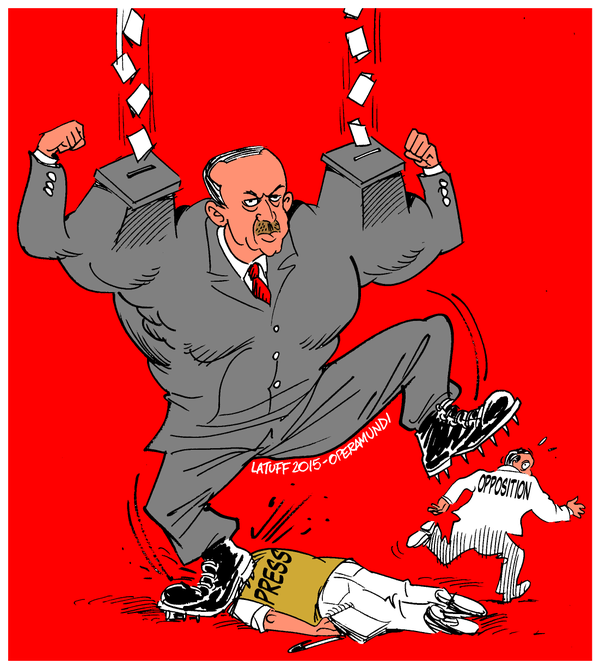
The referendum which President Recep Tayyip Erdoğan is currently putting to vote around the world and in Turkey on April 16 will bring about a complete overhaul in the Turkish system of governance.
The change will abolish the office of the prime minister and concentrate dictatorial power in the president’s hands.
If the referendum is successful, Erdoğan could stay on as president not only for two terms, until 2029, but also uncontested.
Unfortunately, all opposition is just about wiped out, due to the systematic crackdown against any dissent in Turkey by President Erdogan.
Turks in Turkey today seem reluctant to protest this anti-democratic (Referendum) move.
In Turkey itself the Pew Research Center finds that on a number of issues, Turks are almost evenly split between those who are happy with Erdogan’s leadership and the state of the nation, and those who believe the former Istanbul mayor is leading the country down the wrong path. Overall, 44% are satisfied with the country’s direction, while 51% are dissatisfied. Half say the economy is doing well, while 46% think it is in bad shape. Forty-eight percent say Erdogan is having a good influence on the country, while the same percentage believes he is having a negative impact.
 |
| Young and old taking voting rights very serious |
Given early exit polls, verified by EU-Digest, the yes vote in Europe is ahead by about 2 % , while in the US and Canada, which both have a larger number of higher educated and economically more prosperous Turks than in Europe, the no vote is ahead by close to 35 %
With Democracy seemingly on the way out in Turkey it is remarkable, that when U.S. Secretary of State Rex Tillerson visited Turkey last week he failed to raise concerns that the country may be sliding toward a dictatorship and made no mention at all of mass arrests of protesters and the purge of opponents that followed last year’s failed coup attempt, or the crackdown on the news media. Turkey now has more than half of the world’s journalists in jail.
Turkey is also internally at war with the Kurds, which make up close to a quarter of its population,
As of today the Erdogan Government has dismissed over 130,000 people from their jobs and filled the prisons with them. Also some 6,300 academics were fired from their jobs, while fifteen universities were closed.
Bottom-line, a win for NO in the referendum is probably the last chance for Turkey to reestablish a more positive image of the country abroad and the fact that Democracy there is not totally dead.
EU-Digest
Sunday, March 12, 2017
Turkey’s Tyrannical Rule, Erdogan’s “Democratic Dictatorship” - by Stephen Lendman
 |
| The Boss is a dictator - vote NO |
He purged or imprisoned over 100,000 regime critics – from the judiciary, military, police, media and academia.
His state of emergency imposed after last summer’s coup attempt “target(s) criticism, not terrorism,” according to UN High Commissioner for human rights, Zeid Ra’ad al-Hussein.
He uses emergency powers to target dissent, aimed at consolidating unchallenged power.
He’s accused of disappearing opponents, extrajudicial killings, torture, and other flagrant human rights abuses.
Last year, he cited Hitler as a role model, calling his Nazi regime perhaps an ideal way to run Turkey, saying he wants things streamlined for more effective decision-making – code language for wanting iron-fisted rule, all challengers and critics eliminated.
He’s at war with Kurds in Turkey, Syria and Iraq, committing atrocities on the phony pretext of combating terrorism he supports – claiming he has a “historical (regional) responsibility.”
A row between Berlin and Ankara erupted after local German authorities cancelled campaign events Turkish ministers arranged to speak at in support of an April referendum on expanding Erdogan’s presidential powers.
About 1.4 million Turkish nationals live in Germany, eligible to vote in the referendum.
Chancellor Angela Merkel said she had nothing to do with it. Ignoring his own tyrannical rule, Erdogan responded angrily, saying “Germany, you have no relation whatsoever to democracy and you should know that your current actions are no different to those of the Nazi period.”
His spokesman Ibrahim Kalin claimed “(a) huge anti-Turkey, anti-Erdogan attitude is being systematically produced and serviced to the world, especially through Germany.”
Merkel said his accusations “cannot be justified. We will not allow the victims of the Nazis to be trivialized. These comparisons with the Nazis must stop.”
Last month, Die Welt reporter Deniz Yucel, with dual German/Turkish citizenship, was detained in Istanbul, accused of spying for Berlin and representing the outlawed Kurdish PKK group.
Germany called the charges “absurd.” Merkel told parliament her government is working “with all its means” to free him.
A separate row erupted after the Netherlands canceled flight clearance for Turkish Prime Minister Melvut Cavusoglu’s scheduled March 11 visit to Rotterdam to speak at a pro-Erdogan rally.
Dutch Prime Minister Mark Rutte said Ankara wasn’t respecting public gathering rules, explaining:
“Many Dutch people with a Turkish background are authorized to vote in the referendum over the Turkish constitution. The Dutch government does not have any protest against gatherings in our country to inform them about it.”
“But these gatherings may not contribute to tensions in our society and everyone who wants to hold a gathering is obliged to follow instructions of those in authority so that public order and safety can be guaranteed.”
Cavusoglu angrily responded, saying “(i)f the Netherlands cancels my flight clearance today, then we will impose severe sanctions,” adding he intends flying to the country later on Saturday.
A Dutch government statement said his “sanctions threat made search for a reasonable solution impossible.”
Erdogan called Dutch authorities “Nazi remnants, fascists,” warning they’ll be impeded from traveling to Turkey.
How this row gets resolved remains to be seen. Dealings with Erdogan are never easy.
Note EU-Digest: Turkey under leadership of Erdogan is an ever increasing disaster: It is time for the EU, the NATO and democratic countries around the world to call a Spade a Spade and wake up to the fact that it is impossible to deal with this Turkish narcissist president.
He already is a dictator - has no respect for the present Turkish Constitution, election laws (which forbid the Turkish Government and citizens to hold political rallies abroad); locked up more journalists than China; and has enriched himself and his family with money from illegal business deals .Erdogan's so-called referendum on April 16, 2017 is nothing more than a further attempt to amass more power and influence.. YES INDEED, TURKS AROUND THE WORLD NEED TO PROTECT TURKEY FROM DESTRUCTION AND VOTE NO.
Read more: Turkey’s Tyrannical Rule, Erdogan’s “Democratic Dictatorship” | Global Research - Centre for Research on Globalization

Wednesday, March 8, 2017
Turkey has stepped up spying in Germany, says Berlin
 |
| Erdogan Dictatorship Referendum |
Amid ongoing diplomatic unrest, German intelligence has reported an increase in Turkish spying in Germany. Turkey's Foreign Minister meanwhile has said Berlin "must decide whether Germany is a friend or not."
Read more: Symbolbild NSU Affäre Verfassungsschutz Jahrestag Terrorismus Rechtsradikale (picture-alliance/dpa)
While tensions between Berlin and Ankara have escalated ahead of next month's referendum on Turkey's presidency, the German government said on Wednesday that there has been a significant increase in Turkish spying in Germany.
Germany's domestic intelligence agency, the BfV, said divisions in Turkey leading up to the controversial April 16 referendum on boosting the powers of President Recep Tayyip Erdogan were mirrored in Germany.
"The BfV is observing a significant increase in intelligence efforts by Turkey in Germany," it said in a statement. No further details were provided.
Already strained relations between Germany and Turkey reached a new low this month in a row over canceled Turkish political rallies to drum up support for the impending referendum.
Some 1.4 million Turks living in Germany are eligible to cast their ballot in the vote.
Hoping to calm the storm on Wednesday, German Foreign Minister Sigmar Gabriel met with his Turkish counterpart Melvut Cavusoglu in Berlin. While both diplomats agreed on the importance of good relations, Cavusoglu said that Germany must now "decide whether Turkey is a friend or not."
In light of recent comments from both Cavusoglu and Erdogan, Gabriel also made it clear that in maintaining good relations "there are lines that should not be crossed."
"...And one of those is the comparison with Nazi Germany," Gabriel said.
Cavusoglu, meanwhile, said he would host Gabriel for a new round of talks in Turkey "as soon as possible."
In a bid to secure support ahead of next month's referendum, Erdogan himself is also due to hold a rally in Germany. Critics have warned, however that the proposed presidential system which seeks to expand Erdogan's powers as president would cement a one-man rule in the country.
Read more: Turkey has stepped up spying in Germany, says Berlin | News | DW.COM | 08.03.2017
Thursday, November 10, 2016
US - EU relations: Europe forced off the US lap and Alone in Trump’s World
 |
| Will Trump signal the end of the Trans=Atlantic Alliance |
There have been ups and downs in the alliance with the United States, but it was a family relationship built on a sense that we would be there for each other in a crisis and that we are fundamentally like-minded.
Donald Trump’s election as US president threatens to bring this to an end – at least for now. He believes more in walls and oceans than solidarity with allies, and has made it clear that he will put America not just first, but second and third as well. “We will no longer surrender this country, or its people,” he declared in his one major foreign-policy speech, “to the false song of globalism.”
Europeans will not only have to get used to Trump; they will have to look at the world through different eyes. There are four reasons to expect that Trump’s America will be the single biggest source of global disorder.
First, American guarantees are no longer reliable. Trump has questioned whether he would defend Eastern European NATO members if they do not do more to defend themselves. He has said that Saudi Arabia should pay for American security. He has encouraged Japan and South Korea to obtain nuclear weapons. In Europe, the Middle East, and Asia, Trump has made it clear that America will no longer play the role of policeman; instead, it will be a private security company open for hire.
Second, global institutions will come under attack. Trump fundamentally rejects the view that the liberal world order that the US built after WWII (and expanded after the Cold War) is the cheapest way of defending American values and interests. Like George W. Bush after September 11, 2001, he views global institutions as placing intolerable constraints on US freedom of action. He has a revisionist agenda for almost all of these bodies, from the World Trade Organization to NATO and the United Nations.
The fact that he wants to put the “Art of the Deal” into practice in all international relationships – renegotiating the terms of every agreement – is likely to provoke a similar backlash among America’s partners.
Third, Trump will turn all US relationships on their head. The crude fear is that he will be kinder to America’s foes than to its allies. Most challenging for Europeans is his admiration for Russian President Vladimir Putin. Should Trump, cozying up to Putin in search of a grand bargain, recognize Russia’s 2014 annexation of Crimea, the EU would be placed in a near-impossible role.
Fourth, there is Trump’s unpredictability. Even during the 18 months of the presidential campaign, Trump has been on both sides of almost every issue. The fact that he will say the opposite today of what he said yesterday, without admitting that he has changed his mind, shows the extent to which capriciousness is his method.
One of the benefits the US political system is that it provides a two-month grace period to prepare for Trump’s world. So what should Europeans do about it?
First, we need to try to increase leverage over the US. We know from Trump’s writings and behavior that he is likely to resemble other strongmen presidents and treat weakness as an invitation to aggression. We saw from the Iraq experience that a divided Europe has little ability to influence the US. But where Europe has worked together – on privacy, competition policy, and taxation – it has dealt with the US from a position of strength.
The same was true with the so-called E3+3 policy on Iran – when the big EU member states shifted the US stance by standing together. To get on the front foot, the EU now needs to launch a process to agree on common policies on security, foreign policy, migration, and the economy. This will be difficult, as Europe is deeply divided, with France fearing terrorism, Poland dreading Russia, Germany inflamed by the refugee issue, and the United Kingdom determined to go it alone.
Second, Europeans should show that they are able to hedge their bets and build alliances with others. The EU must reach out to other powers to help shore up global institutions against Trumpian revisionism. And it also needs to diversify its foreign-policy relationships. Rather than waiting for Trump to marginalize the EU over Russia and China, Europeans should fly some kites of their own. Should they, for example, begin consulting with the Chinese on the EU arms embargo to remind the US of the value of the transatlantic alliance? Could the EU develop a different relationship with Japan? And if Trump wants to cozy up to Russia, maybe he should take over the Normandy process on Ukraine?
Third, Europeans need to start to invest in their own security. From Ukraine to Syria, from cyber attacks to terror attacks, Europe’s security is being probed in different ways. Despite an intellectual understanding that 500 million Europeans can no longer contract out their security to 300 million Americans, the EU has done little to close the gap between its security needs and its capabilities. It is time to put meat on the bones of the Franco-German plan for European defense. And it will be important to find institutionalized ways of binding the UK into Europe’s new security architecture.
In all of these areas, Europeans must keep the door to transatlantic cooperation open. This alliance – which has so often saved Europe from itself – is bigger than any individual. And, in any case, Trump will not last forever. But the transatlantic relationship will be more likely to survive if it is built on two pillars that understand and defend their own interests.
This will be a tough agenda to adopt – not least because Europe is facing its own brand of populist nationalism. France’s far-right National Front leader, Marine Le Pen, was among the first to congratulate Trump on his victory, and Trump has said that he would put the UK at the front of the queue after Brexit. But even Europe’s most Trump-like leaders will find it harder to defend their national interest if they try to go it alone. To survive in Trump’s world, they should try to make Europe great again.
Read more: Europe, Alone in Trump’s World | European Council on Foreign Relations
Wednesday, November 9, 2016
USA - Donald Trump: The US has elected its most dangerous leader. We all have plenty to fear - by Jonathan Freedland

People all around the world had watched and waited, through the consecutive horrors of the 2016 election campaign, believing the Trump nightmare would eventually pass. But today the United States – the country that had, from its birth, seen itself as a beacon that would inspire the world, a society that praised itself as “the last best hope of earth”, the nation that had seemed to be bending the arc of history towards justice, as Barack Obama so memorably put it on this same morning eight years ago – has stepped into the abyss.
Today the United States stands not as a source of inspiration to the rest of the world but as a source of fear. Instead of hailing its first female president, it seems poised to hand the awesome power of its highest office to a man who revels in his own ignorance, racism and misogyny. One who knows him well describes him as a dangerous “sociopath”.
And what awesome power he will soon have. Republicans did not just defy almost every projection, prediction and data-rich computer model to win the presidency. They also won the House of Representatives and much of the Senate. Trump will face few checks on his whims. A man with no control of his impulses will be unrestrained, the might of a superpower at the service of his ego and his id.
The most obvious impact will be on the country he will soon rule. Just think of what he has promised. A deportation force to round up and expel the 11 million undocumented migrants who make up 6% of the US workforce. A ban on all Muslims entering the country, later downgraded to a pledge to impose “extreme vetting” on anyone coming from a suspect land. A giant wall to seal off the Mexican border. “Some form of punishment” for women who seek an abortion. And prison for the woman he just defeated.
People will say that all that was just talk. But they said that throughout the campaign, insisting that Trump would “pivot” to a more moderate stance, that he would become more “presidential”. He never did. And surely he will see this victory as proof that he was always right, that his instincts are perfect and never to be challenged. There is no reason for him to moderate at all. The office of Thomas Jefferson, Abraham Lincoln, Franklin Roosevelt and John F Kennedy is now his playpen. He can do what he likes.
This will be America’s ordeal primarily. But it will affect all of us. A reality TV star with no experience of either politics or the military will have the nuclear button as his toy. This, remember, is the man who reportedly asked several times, during a military briefing, why the US didn’t use nuclear weapons since it had them. This is the man who has said “I love war”. Whose proposed solution to Isis is “to bomb the shit out of them” and steal the oil.
Think of the anxiety this morning in Riga, Vilnius or Tallinn. In the summer, Trump told the New York Times he did not believe in Nato’s core principle: that an attack on one member should be met by a response from all. He seemed to see Nato as a mafia protection racket: unless the little guys paid up, they should be left undefended. Vladimir Putin – Trump’s hero, admired as the very model of a leader by the president-elect of the United States – will not need more of a hint than that. The Russian dictator will surely see his opportunity to invade one or more Baltic states and expand his empire. President Trump would only admire the macho swagger of such a move.
A trade war looms with China, the imposition of tariffs that could imperil the entire global trading system. America is about to turn inward, towards protectionism. The markets have already delivered their verdict on that. They plunged.
And what about our planet? Trump believes climate change is a hoax perpetrated by the Chinese. He will do nothing to reduce emissions: he does not believe they exist.
But beyond all that, there is another consequence of this terrifying decision, no less dark. Trump’s success has delighted white nationalists and racists in his own country and beyond. His victories in the key battleground states were hailed by David Duke, a former luminary of the Ku Klux Klan: “God Bless Donald Trump,” he tweeted. “It’s TIME TO TAKE AMERICA BACK.” The Dutch nationalist Geert Wilders was in similarly cheery mood: “The people are taking their country back,” he said, “So will we.” Marine Le Pen will feel the same jubilation, as will every other populist or nationalist who traffics in hate.
For they have seen the power of a message built on fear and loathing. It’s not good enough to say this is all about the economic anxiety of those who have been left behind, though that clearly played a part in winning rustbelt states for Trump. But it’s an incomplete explanation because Trump did not only win those voters. He won 63% of white men and 52% of white women. Not all of those were the left behind. A lot of them were people drawn to a message that was, in part and however thinly coded, about reinstating white privilege.
Who is to blame? The list is so long, from the Republican party to the media, from the pollsters and data nerds who got it so wrong to the Clinton campaign team that took onetime Democratic bastions for granted, including Clinton herself, who for all her strengths was a flawed candidate. You can condemn all of them, but on a day like this who really cares about blame? The most powerful country in the world is to be led by its most dangerous ever leader, a figure who could have walked out of a school textbook narrating the darkest history of the 20th century. The wartime holder of the office that in January will be Trump’s once told Americans they had “nothing to fear but fear itself”. That is not true today. America and the rest of us have plenty to fear – starting with the man who now stands on top of the world.
Note Insure-Digest: Maybe also time to give Trump the benefit of the doubt. Donald Trump - Amazing, and shocking for many, but not unexpected. First Brexit and now Trump. Get ready for Marie Le Pen in France and Geert Wilders in Holland. It will certainly create a chain reaction of popular movements around the world against a totally corrupt political, and corporite establishment who slowly dug their own grave. It will be either the beginning of a new era or the beginning of the end. Will Trump be able to deliver and satisfy this popular movement? One thing is certain, the status-quo has been hit by an earthquake. "Business as usual" is no more. QUE SERA SERA!
Read more: The US has elected its most dangerous leader. We all have plenty to fear | Jonathan Freedland | Opinion | The Guardian
Tuesday, September 6, 2016
The Netherlands: "Turkish PM Erdogan should first look at messTurkey is in before criticising other nations",says Dutch Citizen from Turkish descent
 |
| Turkey gone adrift? |
Turkish foreign minister Tanju Bilgiç, who as a Dutch member of parliament said,"should be better informed", keeps referring in his statements to Turkish people living in the Netherlands", but they are in fact Dutch Citizens from Turkish descent, some even second and third generation descent.
Unfortunately, if Mr Tanju Bilgiç and Mr. Erdogan like it or not, the people in question are Dutch citizens and automatically fall under Dutch law.
Obviously, as the Dutch PM Rutte also said, if any Dutch Citizen from foreign descent feels more attracted and loyal to his former country of origin and has difficulty to integrate in his new home country, he is always free to go.
The Turkish Foreign Minister spokesperson Tanju Bilgiç, however, said that the remarks made by the Dutch prime minister on the Dutch TV channel NPO 1, about the Turkish nation and people, are not appropriate for a prime minister to make, adding that Rutte used an isolated incident and turned it into a precedent about "Turkish people" living in Netherlands.
Tanju Bilgiç also noted "in a time where xenophobic statements and attacks are on the rise, these remarks will harm our efforts to help Turkish people participate in the social life of the country they reside".
Several non-demonstrating Dutch citizens of Turkish origin, who were also interviewed afterwards on Dutch TV and Radio stations, said they could not believe the arrogance of the Turkish government in trying to meddle in not only Dutch government affairs, but also in those of many other EU bations.
One person interviewed noted: ""why doesn't Prime Minister Erdogan look at the mess he created in Turkey before being critical of other countries ? "
In the meantime Dutch police on Monday, September 4, detained a 42-year-old Dutchman of Turkish descent for alleged death threats and hate speech after the failed Turkish coup in July, which has ratcheted up tension among Dutch citizens from Turkish descent in the Netherlands.
EU-Digest
Saturday, March 19, 2016
EU - TTIP : Big business and US to have major say in EU trade deals, leak reveals-by Paul Gallagher
 |
| Say No To TTIP |
A leaked document obtained by campaign group Corporate Europe Observatory (CEO) and the Independent from the ongoing EU-US Transatlantic Trade and Investment Partnership (TTIP) negotiations reveals the unelected Commission will have authority to decide in which areas there should be cooperation with the US – leaving EU member states and the European Parliament further sidelined.
The main objective of TTIP is to harmonise transatlantic rules in a range of areas – including food and consumer product safety, environmental protection, financial services and banking.
The leaked document concerns the “regulatory cooperation” chapter of the talks, which the European Union says will result in “cutting red tape for EU firms without cutting corners”. It shows a labyrinth of procedures that could tie up any EU proposals that go against US interests, according to analysis by CEO.
The campaign group said the document also reveals the extent to which major corporations and industry groups will be able to influence the development of regulatory cooperation by making what is referred to as a “substantial proposal” to the working agenda of the Commission and US agencies.
The plans revealed by the document will give the US regulatory authorities a “questionable role” in Brussels lawmaking and weaken the European Parliament, CEO argues.
Read more: TTIP: Big business and US to have major say in EU trade deals, leak reveals | Business News | News | The Independent
Subscribe to:
Posts (Atom)