ANNUAL ADVERTISING RATES FOR INSURE-DIGEST

Annual Advertisement Rates
Showing posts with label Recep Tayip Erdogan. Show all posts

Wednesday, August 1, 2018

Turkey-US Relations: Trump White House sanctions Turkey over pastor Andrew Brunson - by Alex Ward

President Donald Trump announced that he would sanction Turkey for detaining an American pastor — a move that could further imperil the already tense relationship between Washington and Ankara.

The president is “not happy with Turkey’s decision” to continue to detain the man who has been held for nearly two years, White House press secretary Sarah Sanders said on Wednesday. Trump ordered sanctions that target two top Turkish officials — the minister of justice and minister of interior — for their role in the issue.

Turkey, a NATO ally, responded by calling the sanctions “unacceptable” and promised to retaliate. Turkish Foreign Minister Mevlüt Çavuşoğlu tweeted after the announcement that the US can’t “obtain unlawful requests” in this way. The Turkish lira, meanwhile, has dropped in anticipation of the sanctions.

The pastor in question, Andrew Brunson, is originally from North Carolina but has lived in Turkey for more than 20 years. Turkish authorities detained him on October 7, 2016, claiming that he was a spy and had connections to a terrorist group. The US expected him to be released on July 18, but on Wednesday, Turkish officials moved Brunson due to health concerns and kept him under house arrest.

The charges he’s facing mean he could spend the rest of his life in prison.

Trump has repeatedly called Brunson a “great Christian” and expressed his displeasure over the pastor’s detainment for months, but hadn’t taken significant action before Thursday. It’s unclear, though, why Trump decided to escalate this issue now, or what the sanctions he promised to impose might look like.

On July 26, Vice President Mike Pence had noted the possibility of sanctions during a speech at a conference on religious freedom. After the speech, Trump tweeted that he would follow through on the threat.

Read more: Trump White House sanctions Turkey over pastor Andrew

Saturday, June 16, 2018

Turkey - Presidential Elections: Can Erdogan's economic record help him keep seat amid challenges? - by Umut Uras

Sitting by his small telephone sale and repair shop in the buzzing Istanbul district of Besiktas, Hasan Kus is pessimistic about the future of Turkey's economy.

A little over a week before the country's key elections, the 44-year-old believes the financial situation will worsen regardless the outcome of the June 24 polls. "People are merely trying to pick the better scenario, compared to the other ones," says Kus, before trying to sell a phone charger to a customer.

The economy is going to be a decisive factor in the upcoming vote that will transition Turkey from a parliamentary system to an executive one, in line with constitutional changes approved in a referendum last year.

The presidential and parliamentary polls will be held under a state of emergency, in place since July 2016 following a failed deadly coup blamed by the government on the movement of Fethullah Gulen, a US-based self-exiled religious leader.

On the economic front, the polls come against a conflicting backdrop of skyrocketing growth rate - up 7.4 percent last year - and a depreciating currency.

The Turkish lira dropped more than 20 percent against the US dollar this year, prompting the Central Bank to raise interest rates multiple times to shore up one of the world's worst-performing currencies. Meanwhile, both inflation and current account deficit are on the rise.

Under these circumstances, the Turkish electorate appears divided about who is best equipped to deal with the ongoing economic uncertainties.

Voters who blame the uncertainty on President Recep Tayyip Erdogan and his ruling Justice and Development Party (AK Party) believe change is needed after 15 years to correct the policies that spawned the current problems. 

Note EU-Digest: It is time for a change in Turkey after 15 years of Erdogan. President Erdogan has brought Turkey close to total economic ruin, and based on latest polls can only win the upcoming Presidential elections if he succeeds, once again, to have his associates fiddle with the ballot boxes and votes to change the outcome......?

Monday, August 14, 2017

Turkey’s economy: The next casualty of Erdoğan’s state of emergency – by Aykan Erdemir


For the past year, Turkish President Recep Tayyip Erdoğan has exploited his country’s state of emergency to rule by decree, purging government ranks, imprisoning political dissenters and crushing independent media. But for all the attention paid to Turkey’s slippage in democratic norms, critics have largely ignored the heavy toll his brand of authoritarianism has taken on the country’s economy. The effects could be disastrous for Turkey’s future.

When Erdoğan first became prime minister in 2003, he inherited a struggling economy with a long list of structural problems. His greatest achievement during the first half of his 15-year tenure at the pinnacle of political power was to stick to a reform plan devised by the World Bank’s former Vice President Kemal Derviş and reorient Turkey’s foreign policy toward trade diplomacy.

But as he has consolidated power, he has become both more self-confident and more corrupt, replacing his original reform agenda with cronyism, nepotism and graft. Unless he ends his disastrous meddling in Turkish markets, the country’s volatile economy may well become the next casualty of last year’s abortive coup.

Turkey was already suffering from slowing growth and the highest percentage of youth not in employment, education or training, and the lowest labor force participation among OECD members. Morgan Stanley branded the country as one of “the Fragile Five” — overly dependent on short-term investment to finance its gaping current account deficit.

A key challenge for Turkey’s economy has long been weak governance. In 1995, a grand coalition of center-right and center-left parties established the Economic and Social Council, a quarterly consultative body to assemble labor, public, and private sector representatives to facilitate good governance.

But Erdoğan has refused to convene the Council since 2009, despite repeated calls to do so from the opposition. Under the current state of emergency, most economic decisions no longer involve parliament deliberations. They are simply the result of arbitrary decrees.

Erdoğan, for example, transferred the government’s stakes in Turkey’s flag carrier airline, two top public lenders, and fixed-line phone operator to the country’s newly-established sovereign wealth fund — and he did this simply with a decree.

The controversial fund is neither transparent nor accountable, and it’s exempt from the oversight of the Court of Accounts, which is responsible for auditing public administrative bodies.

To make matters worse, the fund is managed by cronies, including an Erdoğan adviser who once claimed foreign powers were trying to kill the president by “telekinesis.”

Turkey’s deteriorating rule of law has also eroded private property rights. In the past year alone, the government seized 879 businesses with assets worth over $11 billion, prompting potential buyers to worry about prolonged legal battles over ownership. The appointment of party loyalists to run these firms has only aggravated cronyism and mismanagement.

Read more: Turkey’s economy: The next casualty of Erdoğan’s state of emergency – POLITICO

Monday, May 15, 2017

USA-Turkey relations: Why Trump will likely leave Erdogan empty-handed - by Nil Köksal

The conversations so far have been cordial, diplomatic. There's so much on the line.

But just days before U.S. President Donald Trump was set to meet Turkish counterpart Recep Tayyip Erdogan at the White House, Washington delivered a welcome basket loaded with a land mine.

Actual weapons and who gets them are the issue. Knowing that one of Turkey's biggest demands of the U.S. is not to arm certain Kurdish fighters in Syria, the White House announced last week it would be doing just that.
The decision dropped just as a high-level delegation, including the head of Turkey's Armed Forces, the intelligence service and Erdogan's chief adviser, was in Washington for meetings ahead of the main event Tuesday.

"It will be a tough meeting," said Prof. Huseyin Bagci of Middle East Technical University in Ankara.

Read more: Why Trump will likely leave Erdogan empty-handed - World - CBC News

Tuesday, April 18, 2017

US - Turkey Relations: Pres. Trump’s deafening silence on Turkey dictatorship: Are business interests muzzling POTUS? - by Jordan Schachtel

Birds of a feather flock together
Are President Trump’s business ties to Istanbul stopping him from reprimanding the Turkish president for his authoritarian power grab?

On Monday, Trump congratulated Turkish dictator Recep Tayyip Erdogan for a referendum victory (contested as undemocratic by multiple international monitoring organizations) that boosted his unilateral authority over his country.

Further, “[T]he leaders agreed on the importance of holding Syrian President Bashar al-Assad accountable,” a readout of his call with Erdogan said. “President Trump and President Erdogan also discussed the counter-ISIS campaign and the need to cooperate against all groups that use terrorism to achieve their ends,” the statement concluded.

Over the past several months, Turkey has continued to move in the direction of becoming a full-blown Islamist tyranny.

President Erdogan, whose AKP party continues to push for an Islamist ideology that rejects Turkey’s founding as a secular country, has continued to cozy up with terror advocates like the Muslim Brotherhood and its subgroup Hamas. Some have even alleged that top officials in Ankara are responsible for financing operations by the Islamic State terror group.

Erdogan has pushed a vicious crackdown of any type of dissent. After Erdogan said that members of a rogue party attempted a military coup, the authoritarian leader has rounded up tens of thousands of military officials, journalists, academics, students, and others who he has alleged are part of a movement that is attempting to overthrow his seat of power.

But this isn’t exactly a new problem. Under Erdogan, Turkey has, year after year, become less free and more authoritarian, according to Freedom House.

So why hasn’t President Donald Trump called Turkey out for its gross violations of basic human rights? Is it simply because he wants to hold together the NATO alliance, or are there more selfish and financial motives at play?

One explanation points to his notable business interests there.

The president has licensed his name to a towering development in Istanbul. The agreement makes him an estimated $1 to 5 million per year, according to reports. Trump even admitted in 2015 that he has a “conflict of interest” when it comes to Turkey.

“I have a little conflict of interest ’because I have a major, major building in Istanbul. It’s called Trump Towers. Two towers, instead of one. Not the usual one, it’s two. And I’ve gotten to know Turkey very well,” the president said in a December 2015 radio interview describing his Istanbul property.

And on social media, Trump has repeatedly tweeted excitedly about his property there, and his love for Istanbul.
But this isn’t exactly a new problem. Under Erdogan, Turkey has, year after year, become less free and more authoritarian, according to Freedom House. - See more at: https://www.conservativereview.com/commentary/2017/04/pres-trumps-deafening-silence-on-turkey-dictatorship-are-business-interests-muzzling-potus#sthash.IP3H104r.dpuf

Read more: Pres. Trump’s deafening silence on Turkey dictatorship: Are business interests muzzling POTUS?

Monday, April 17, 2017

Turkey: Trump Congratulates Erdogan on the disputed Referendum Vote

President Trump called to congratulate Turkish President ­Recep Tayyip Erdogan on Monday after a referendum greatly expanding his powers, despite a more circumspect State Department response to Sunday’s vote, which international election observers declared unfair.

According to accounts by both Trump and Erdogan, the two also discussed the U.S. missile strike on a Syrian air base in response to the April 4 chemical weapons attack on civilians in Idlib province. Trump thanked Erdogan for Turkey’s support of the retaliatory action.

The "leaders" agreed that Syrian President Bashar al-Assad should be held accountable for the chemical attack that killed at least 70 people, and they talked about the ongoing campaign to counter the Islamic State.

Trump’s comments differed in tone from those of the State Department, which urged Turkey to respect the basic rights of its citizens and noted the election irregularities witnessed by monitors with the Organization for Security and Cooperation in Europe. The United States is a member of the OSCE.

Note EU-Digest: Even though the OSCE/ODIHR, observers who were in Turkey offered a harsh analysis on the way the Turkish referendum was conducted and noted "The legal framework for the referendum neither sufficiently provided for impartial coverage nor guarantees eligible political parties equal access to public media." President Trump for some bizarre reason went ahead and congratulated Erdogan. What makes this even more bizarre is that this was not about Erdogan winning an election, but that it was about a contested referendum. 

Very poor judgement on the part of President Trump to support a disputed vote in a foreign country and thereby indirectly supporting a very tainted political leader of that country  .


 EU-Digest

Saturday, April 15, 2017

Turkey-EU ties: a bargaining chip on eve of referendum

Turkey’s president Tayyip Erdogan has ramped up his anti-EU rhetoric on the eve of a referendum which would hand him sweeping powers.

Erdogan said he would review Ankara’s relationship with Brussels, as he seeks to shore up support for the constitutional changes needed to transfer more power away from parliament to the president.

Turkey’s president Tayyip Erdogan has ramped up his anti-EU rhetoric on the eve of a referendum which would hand him sweeping powers.

Erdogan said he would review Ankara’s relationship with Brussels, as he seeks to shore up support for the constitutional changes needed to transfer more power away from parliament to the president.

“The EU has lost all credibility. We don’t defend democracy, human rights and freedoms because they want us to, we do that because our citizens deserve it. As we get closer to democracy, they are moving away from it,” Erdogan told supporters at a rally in Istanbul.

He continued saying that the EU feared the new system because Turkey would be ‘even stronger’. In his speech he said that the EU had left Turkey waiting 54 years for membership, and that the vote on Sunday would be a turning point.

Over the course of the campaign Erdogan’s speeches have shown a clear shift in ties with Brussels, becoming far more critical of the 27-member bloc. When ministers attempted to campaign in EU countries, there was a clampdown on rallies and Erdogan responded by calling leaders ‘fascists’ and ‘Nazis’.

Also in Istanbul, the ‘No’ campaign formed a symbolic human chain on the European side of the Bosphorous strait which divides Asia and Europe.

They fear the constitutional changes would see Turkey lurch towards authoritarianism. The new system could allow Erdogan to run for two more terms, potentially stretching his rule to 2029.

“I have two children. I’m here for my children and for a Turkey where the values I was born with remain, where my children can continue to think freely and where journalists and teachers are not put behind bars,” said one ‘No’ supporter.

The vote comes at a time of turmoil, with the country reeling from a series of bombings by ISIL and Kurdish militants, a failed coup and subsequent purge as well as a deep economic slowdown, something which the president says requires a stronger leadership to bring under control.

Turkey-EU ties: a bargaining chip on eve of referendum | Euronews

Wednesday, April 12, 2017

Turkish Referendum - "Erdogan's Turkey" - by Mark Lowen EU-Digest

Referendum: Is Turkey moving
towards a legalized dictatorship 
A BBC special report on Turkey notes:  "Some guests were awoken by the gunshots, others by the buzzing of three Black Hawk helicopters"

It was the early hours of 16 July 2016. Around two-dozen Turkish commandos dropped into the grounds of the luxury Club Turban hotel in the coastal resort of Marmaris, armed with automatic rifles and grenades.

They were hunting one man - Recep Tayyip Erdogan. The president had been holidaying at a private villa linked to the hotel. Commandos had been sent to capture the president. It should have been the climax of their coup d'etat. Opening fire and hurling grenades, they stormed the hotel, killing two bodyguards. But they were too late.

 Acting on a tip-off, Erdogan had been whisked away from the resort by helicopter. Once at Dalaman Airport, he took a private jet to Istanbul, with his pilot masking its identity so it appeared on radars as a normal civilian passenger plane.

After 03:00, the president emerged outside Istanbul's Ataturk Airport to the roars of his supporters.

The coup attempt had failed - and Recep Tayyip Erdogan was to emerge stronger than ever.

Erdogan went from almost losing control of his country to becoming untouchable.

But for Turkey's most powerful leader since its founding father, Mustafa Kemal Ataturk, it wasn't enough. After 11 years as prime minister, Erdogan had been elected president in 2014.

The post was traditionally largely ceremonial but Erdogan had other ideas.

The dominant figure in Turkish politics had long dreamed of enshrining his authority through constitutional change, turning Turkey from a parliamentary to a presidential republic, scrapping the post of prime minister and consolidating his hold on the country.

This previously stable corner of the region has become consumed by terror attacks - once-rapid economic growth has stalled.

Dozens of journalists are in jail. Three million, mostly Syrian, refugees have poured into the country.

Tens of thousands of people have been arrested or dismissed following the failed coup. The country's hope of EU membership is evaporating. And Turkey is arguably more politically polarized than ever.

But at the same time, Turkey has gone from a financial basket-case at the turn of the century into one of the world's top 20 economies.

The middle-class has hugely expanded. Millions of impoverished Turks have been economically emboldened under Erdogan's leadership.

And now, on April 16 the country will vote on its future in a referendum  which: proposes:

*Prime minster role scrapped, new vice president role created
*President becomes head of government as well as state, and can retain political party ties
*President given sweeping powers, with ability to enact laws by decree and dismiss parliament
*Parliament no longer able to scrutinise ministers
*Parliament given limited powers to investigate or impeach president

Basically if this referendum passes on the terms as listed above it will turn Turkey into a democratically legalized dictatorship.

Sunday, April 2, 2017

Turkish Referendum: Turkish citizens living abroad have started voting at their Embassies and Consulates - by RM

Voting referendum has started

Large numbers of Turks all over the world have started going to the polls since March 27 to vote yes or no on a new Turkish Constitution,

The referendum which President Recep Tayyip Erdoğan is currently putting to vote around the world and in Turkey on April 16 will bring about a complete overhaul in the Turkish system of governance.

The change will abolish the office of the prime minister and concentrate dictatorial power in the president’s hands.

If the referendum is successful, Erdoğan could stay on as president not only for two terms, until 2029, but also uncontested.

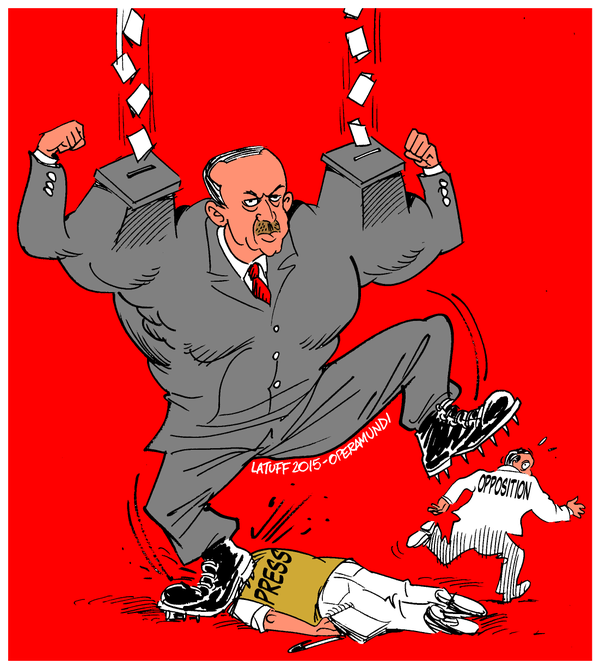
Unfortunately, all opposition is just about wiped out, due to the systematic crackdown against any dissent in Turkey by President Erdogan.

Turks in Turkey today seem reluctant to protest this anti-democratic (Referendum) move.

In Turkey itself the Pew Research Center finds that on a number of issues, Turks are almost evenly split between those who are happy with Erdogan’s leadership and the state of the nation, and those who believe the former Istanbul mayor is leading the country down the wrong path. Overall, 44% are satisfied with the country’s direction, while 51% are dissatisfied. Half say the economy is doing well, while 46% think it is in bad shape. Forty-eight percent say Erdogan is having a good influence on the country, while  the same percentage believes he is having a negative impact.

Young and old taking voting rights very serious
There are some 7 million Turks living outside Turkey, of which close to 5 million live in Europe, approximately half a million in the US, and about 44.000 in Canada. The rest are scattered  around the world

Given early exit polls, verified by EU-Digest, the yes vote in Europe is ahead by about 2 % , while in the US and Canada, which both have a larger number of higher educated and economically more prosperous Turks than in Europe, the no vote is ahead by close to 35 %

With Democracy seemingly  on the way out in Turkey it is remarkable, that when U.S. Secretary of State Rex Tillerson visited Turkey last week he failed to raise concerns that the country may be sliding toward a dictatorship and made no mention at all of mass arrests of protesters and the purge of opponents that followed last year’s failed coup attempt, or the crackdown on the news media.  Turkey now has more than half of the world’s journalists in jail.

Turkey is also  internally at war with the Kurds, which make up close to a quarter of its population,

As of today the Erdogan Government has dismissed over 130,000 people from their jobs and filled the prisons with them. Also some 6,300 academics were fired from their jobs, while fifteen universities were  closed.

Bottom-line, a win for NO in the referendum is probably the last chance for Turkey to reestablish a more positive image of the country abroad and the fact that Democracy there is not totally dead.  

EU-Digest

Saturday, March 18, 2017

Netherlands -Turkey: Economics of the standoff between Turkey and the Netherlands - by Altay Atli

 Mark Rutte and Recep Tayip Erdogan in the better days
As the diplomatic squabble between Turkey and the Netherlands continues to fester, concerns are raised about whether — and to what extent — the tensions will harm bilateral relations, particularly in economics where the two countries have robust trade and investment connections.

For Turkey, the Netherlands offers a large and expanding export market. Trade between the two countries has roots in the 17th century when the Ottomans exported wool and cotton (later tobacco as well) to the Netherlands and imported clothes and linen in return. Commerce between the two
countries remained strong into modern times; in 2016 the bilateral trade volume was US$6.6 billion.

The Netherlands is the 10th largest export destination for Turkey, and perhaps more importantly from the Turkish perspective, it is also a fast-growing market. Last year Turkish exports to the Dutch market amounted to $3.6 billion, against $3 billion in imports. And while the annual increase in imports was 3.4%, exports expanded much faster, at 13.8%. For the Turkish economy, which is suffering an acute current-account deficit, the increasing trade surplus with the Dutch is a precious commodity.

On the other side of the equation, Turkey is and has always been a favored destination for Dutch investment. A process that started in 1930 when the Dutch company Philips set up shop in the newly established Republic of Turkey has reached new levels since then, making the Netherlands by far the largest source of foreign direct investment in Turkey today. According to data by the Turkish Central Bank, Dutch investment stock in Turkey was $22 billion in 2016, compared with $11.2 billion in US investments in second place, and $9.8 billion from Austria in third place.

Turkey is home to 2,700 companies funded by Dutch capital. This figure includes those transnational companies registered in the Netherlands for legal and tax-related purposes. This sizeable Dutch involvement in the Turkish economy benefits both sides. For Dutch multinationals such as Unilever, ING Bank, Philips, Perfetti, Royal Dutch Shell and Philip Morris, Turkey is not only a favorable production base but also a lucrative market and a trading and logistics hub for access to the Middle East and North Africa, Balkans, Caucasus and Central Asia. More Dutch investment is set to come to Turkey, such as the recent purchase by Vitol Group of the Turkey-based fuel products distribution company Petrolofisi for $1.47 billion. Investment needs a stable political climate, and the diplomatic spat between Turkey and the Netherlands doesn’t help.

It is also worth nothing that while the amount of Turkish investment in the Netherlands is considerably smaller, there are several large Turkish firms that have set up subsidiaries enabling access to the larger EU market.

For the past week, Dutch pundits have been commenting that Turkey is more dependent on the Netherlands, so possible sanctions imposed by Ankara would only mean “shooting themselves in the foot.” Turkish authorities have imposed political sanctions over the Dutch government’s refusal to allow Turkish ministers to meet with members of the Turkish diaspora there, including halting high-level political discussions between the two countries and the closing of Turkish airspace to Dutch diplomats. But Ankara has carefully ruled out economic sanctions. Turkey’s economics minister, Nihat Zeybekçi said: “If we take these steps, both sides would be hurt.” Ömer Çelik, minister of EU affairs said the Dutch business community, which is “investing in Turkey, doing commerce and generating employment” is “certainly not a part of this crisis,” and “Dutch investment in Turkey is by no means under risk.”

Economic sanctions between Turkey and the Netherlands don’t seem likely at the moment, but longer-term threats remain. First, even if no sanctions are imposed, the significant loss of confidence caused by recent events will take a toll on bilateral economic relations for some time.
Second, the sizeable Turkish diaspora in the Netherlands, as well as the relatively smaller Dutch community living in Turkey, will face uncertainty, and this will have an economic impact too. An estimated 400,000 Turks live in the Netherlands, according to a diaspora association, and there are 25,000 businesses with Turkish owners, most of them smaller enterprises. Many of these companies are doing business with Turkey, and they are negatively affected by the current dispute between the two governments. So is the much smaller Dutch community in Turkey. But it is equally active in the economy, especially in the tourism sector. Declining tourist numbers will hurt Turkish and Dutch operators alike, and it might take some time to recover to pre-crisis levels of business.

Third, the diplomatic spat is likely to have a negative effect on efforts to revise the Turkish-EU Customs Union. The union, which took effect in 1996, is outdated, failing to catch up with the requirements of today’s global trade. Ankara and Brussels had begun talks to improve the deal, but the current circumstance is likely to overshadow attempts based on economic rationality.

This week Turkish football team Beşiktaş played the Greek side Olympiakos in the European cup. The Turks won 4-1 helped by two goals from Ryan Babel, the Amsterdam-born Dutch striker. Turkey and the Netherlands have links that are closer than many realize, and it will benefit both to keep them intact.

Read more: Economics of the standoff between Turkey and the Netherlands | Asia Times

Saturday, March 11, 2017

Turkey-The Netherlands -EU: Diplomatic row as Dutch withdraw landing rights for Turkish minister's plane

The Netherlands says NO
The Netherlands has withdrawn landing rights for a plane carrying a Turkish government minister who wanted to address a rally in support of a controversial referendum giving more power to the president.

Foreign affairs minister Mevlüt Cavusoglu was planning to speak at a meeting in support of the referendum in Rotterdam late on Saturday afternoon. The decision to stop the plane carrying Cavusoglu from landing was taken on public order grounds. The call by the Turkish authorities for a mass demonstration is a threat to public order and safety, the Dutch foreign affairs ministry said in a statement.

‘The Netherlands was in talks with the Turkish authorities about an acceptable solution to the visit,’ the statement said. Talks were ongoing about whether the meeting could take place in a smaller, closed environment such as a Turkish consulate or the embassy. ‘But before those talks could be completed, the Turkish authorities made a public threat about sanctions.

That made the search for a reasonable solution impossible,’ the statement said. The ministry said that many Dutch Turkish have voting rights in Turkey and that the government has no objection to information meetings. ‘But these meetings cannot contribute to the tensions in our society,’ the statement said.

More powers Cavusoglu hopes to win support for a yes vote in the Turkish referendum on amending the constitution to concentrate more power with president Tayyip Erdogan. Prime minister Mark Rutte has said the visit, planned for just four days before the Dutch general election, is ‘undesirable’.

The timing is inopportune, given that much of the election campaign revolves around maintaining the Dutch identity. It would also be playing into the hands of Geert Wilders, who held a short demonstration for the press in front of the Turkish embassy on Wednesday, Dutch commentators said.

Note EU-Digest: Obviously this move by the Dutch PM will score a lot of points for him in the upcoming Dutch elections in 4 days ,


Read more: Diplomatic row as Dutch withdraw landing rights for Turkish minister's plane - DutchNews.nl

Wednesday, March 8, 2017

Turkey has stepped up spying in Germany, says Berlin

Erdogan Dictatorship Referendum
Turkey has stepped up spying in Germany, says Berlin

Amid ongoing diplomatic unrest, German intelligence has reported an increase in Turkish spying in Germany. Turkey's Foreign Minister meanwhile has said Berlin "must decide whether Germany is a friend or not."

Read more: Symbolbild NSU Affäre Verfassungsschutz Jahrestag Terrorismus Rechtsradikale (picture-alliance/dpa)   

While tensions between Berlin and Ankara have escalated ahead of next month's referendum on Turkey's presidency, the German government said on Wednesday that there has been a significant increase in Turkish spying in Germany.

Germany's domestic intelligence agency, the BfV, said divisions in Turkey leading up to the controversial April 16 referendum on boosting the powers of President Recep Tayyip Erdogan were mirrored in Germany.

"The BfV is observing a significant increase in intelligence efforts by Turkey in Germany," it said in a statement. No further details were provided.

Already strained relations between Germany and Turkey reached a new low this month in a row over canceled Turkish political rallies to drum up support for the impending referendum.

Some 1.4 million Turks living in Germany are eligible to cast their ballot in the vote.

Hoping to calm the storm on Wednesday, German Foreign Minister Sigmar Gabriel met with his Turkish counterpart Melvut Cavusoglu in Berlin. While both diplomats agreed on the importance of good relations, Cavusoglu said that Germany must now "decide whether Turkey is a friend or not."

In light of recent comments from both Cavusoglu and Erdogan, Gabriel also made it clear that in maintaining good relations "there are lines that should not be crossed."

"...And one of those is the comparison with Nazi Germany," Gabriel said.

Cavusoglu, meanwhile, said he would host Gabriel for a new round of talks in Turkey "as soon as possible."

In a bid to secure support ahead of next month's referendum, Erdogan himself is also due to hold a rally in Germany. Critics have warned, however that the proposed presidential system which seeks to expand Erdogan's powers as president would cement a one-man rule in the country.

Read more: Turkey has stepped up spying in Germany, says Berlin | News | DW.COM | 08.03.2017

Monday, November 7, 2016

Turkey - EU Relations: Turkey blasts EU over crackdown criticism


Turkey:A corrupt dictatorship
Turkey protested to EU envoys and branded relations with Brussels as "fragile" on Monday over the bloc's criticism of its crackdown in the wake of the July 15 coup.

In recent days, the European Union has strongly criticised Turkey, a candidate for accession, over the arrests of nine MPs from the pro-Kurdish Peoples' Democratic Party (HDP), including its two co-leaders.

"We made clear our alarm over the positions taken by the EU," Turkish EU Affairs Minister Omer Celik said in televised comments after calling in all EU member state ambassadors for an unusual meeting at his ministry.

"We are in a very fragile period in EU-Turkey relations... Constant opposition to Turkey is not a correct policy," he added.

Celik also lashed out at remarks attributed to an EU minister comparing Turkey's crackdown in the wake of the coup to the methods of the Nazis.

Some 35,000 people have been arrested and tens of thousands more have lost their jobs in the crackdown since the coup bid. The opposition Press was closed down and editors arrested.

Note EU-Digest: Bottom line, if Mr. Erdogan likes it or not: he is now the leader of a Dictatorship without any Freedom of the Press or basic Human Rights and there is no reason whatsoever (except fear)  for the EU to continue dealing with this bully and his puppet government. It is high time the EU shows to have what it takes to put Mr.Erdogan out of business.

Read more: Flash - Turkey blasts EU over crackdown criticism - France 24

Tuesday, September 6, 2016

The Netherlands: "Turkish PM Erdogan should first look at messTurkey is in before criticising other nations",says Dutch Citizen from Turkish descent

Turkey gone adrift?
The Turkish Foreign Ministry criticized Dutch Prime Minister Mark Rutte Tuesday September 5, for his recent remarks about   what he called "Turkish people" living in the Netherlands, saying the prime minister generalized a single incident to reach an overall conclusion.

Turkish foreign minister Tanju Bilgiç, who as a Dutch member of parliament said,"should be better informed", keeps referring in his statements to Turkish people living in the Netherlands", but  they are in fact Dutch Citizens from Turkish descent, some even second and third generation descent.

Unfortunately, if Mr Tanju Bilgiç and Mr. Erdogan like it or not, the people in question are Dutch citizens and automatically fall under Dutch law.

Obviously,  as the Dutch PM Rutte also said, if any Dutch Citizen from foreign descent feels more attracted and loyal to his former country of origin and has difficulty to integrate in his new home country, he is always free to go.

The Turkish Foreign Minister spokesperson Tanju Bilgiç, however, said that the remarks made by the Dutch prime minister on the Dutch TV channel NPO 1, about the Turkish nation and people, are not appropriate for a prime minister to make, adding that Rutte used an isolated incident and turned it into a precedent about "Turkish people" living in Netherlands.

Tanju Bilgiç also noted "in a time where xenophobic statements and attacks are on the rise, these remarks will harm our efforts to help Turkish people participate in the social life of the country they reside".

Several non-demonstrating Dutch citizens of Turkish origin, who were also interviewed afterwards on Dutch TV and Radio stations, said  they could not believe the arrogance of the Turkish government in trying to meddle in not only Dutch government affairs, but also in those of many other EU bations.

One person interviewed noted: ""why doesn't Prime Minister Erdogan look at the mess he created in Turkey before being critical of other countries ? "

In the meantime Dutch police on Monday, September 4, detained a 42-year-old Dutchman of Turkish descent for alleged death threats and hate speech after the failed Turkish coup in July, which has ratcheted up tension among Dutch citizens from Turkish descent in the Netherlands. 

EU-Digest

Thursday, May 5, 2016

Turkey - Turkish lira hammered as political turmoil rattles investors

The Turkish lira remained under pressure Thursday as political uncertainty rattled investors after it emerged Prime Minister Ahmet Davutoglu is set to step down in a move giving President Recep Tayyip Erdogan even more power.

The lira lost almost 4 percent in value against the dollar on Wednesday -- its heaviest daily loss this year -- as news broke that crisis talks between Davutoglu and Erdogan had failed to resolve tensions between the two men.

After that hammering, the lira rallied slightly Thursday to trade at 2.91 to the dollar, a gain of 1.35 percent, but still still well off its 2.85 level against the dollar before the news broke.

"Politics has once again emerged as a major risk for the lira, which is likely to remain vulnerable in the coming days," analysts at Rabobank said in a note to clients.

The ruling Justice and Development Party (AKP) is now set to hold an extraordinary congress where Davutoglu is expected to surrender his twin jobs of party chairman and prime minister.

The equity also took the news badly, with participants fearing the development was a move by Erdogan to tighten his grip on all areas of policy, including the economy.

The Istanbul stock market's benchmark 100 Index lost 1.40 percent to trade at 78,274 points.

Rabobank said Davutoglu had been perceived by markets as being "far more moderate" than Erdogan. "If Davutoglu indeed resigns, it will be a major blow for the lira and Turkish assets," it added.

Erdogan's reputation as a safe pair of hands on the economy was harmed last year when he piled pressure on the nominally independent central bank to cut interest rates for the sake of growth at a time of high inflation.

Read more: Flash - Turkish lira hammered as political turmoil rattles investors - France 24

Friday, April 29, 2016

Turkey: Clearing customs - "but we also come with heavy bagage"

"We were also paid €6 billion to change our flag"
Serhan Turkoglu stands outside one of Istanbul’s many visa-application bureaus, clutching his flight and hotel bookings, travel insurance, proof of employment, social-security registration, recent salary slips and bank statements, and a vehicle licence. Mr Turkoglu, an accountant, needs all of this simply to secure a holiday visa to Spain. For his next European holiday he will have to go through the whole rigmarole again. “It makes you feel like a second-class citizen,” he says.

Turkish diplomacy towards the European Union is focused on obtaining visa-free travel. It is easy to see why. Turkey has been negotiating to accede to the EU for more than a decade; it is the only candidate country whose citizens still need visas to enter the bloc’s Schengen area. Peruvians, Malaysians and Mexicans, by contrast, no longer need visas to travel there.

Europe’s panic in the face of mass migration from the Middle East has provided Turkey with a new opening. In March, in exchange for a pledge to re-admit thousands of migrants deported from Greece, the EU offered Recep Tayyip Erdogan, the country’s president, €6 billion ($6.8 billion) in aid, progress in the moribund membership talks and visa-free travel for his people by June.

To qualify, Turkey must meet 72 benchmarks by late April, from biometric passports to better data-protection. Turkey’s prime minister, Ahmet Davutoglu, claims that his country already meets most of the conditions. But the EU says much more needs to be done. “The criteria will not be watered down,” insists the European Commission’s president, Jean-Claude Juncker.

In fact, it is hard to see how Turkey could meet the political conditions for visa liberaliation. These include bringing its terrorism laws into line with the EU’s, and guaranteeing the rights to assembly and free speech. But for quite some time, Turkey has been restricting political activity and going in the wrong direction on human rights.

The government is prosecuting a group of academics on terrorism charges, after they signed a petition to end a crackdown against the Kurdistan Workers’ Party (PKK) that has raged in Turkey’s south-east since last year. Two journalists face life in prison for reporting on covert arms shipments to Syria.

Last week a Dutch columnist was detained and barred from leaving the country pending trial; her offence was a profane tweet and an article calling Mr Erdogan a “dictator”.

If the commission agrees that Turkey meets the benchmarks, on May 4th it will recommend that the EU’s 28 governments (as well as the European Parliament), approve visa-free travel for Turkey. In theory this could be done by a qualified-majority vote; in practice, rejection by a large country would torpedo the deal. Far-right anti-Muslim parties are surging in many parts of the continent.

With Marine Le Pen looking stronger in the run-up to France’s presidential election in 2017, notes Marc Pierini, a former EU envoy to Turkey, “France cannot afford to vote yes” to visa-free travel.

Turkish officials warn of a diplomatic train crash if they do not get their way. The first victim would be Europe’s migrant deal. “If the EU does not keep its word, we will cancel the readmission agreement,” the country’s foreign minister, Mevlut Cavusoglu, said recently.

Note Insure-Digest: If Turkey cancels the agreement because of Europe's democratic election system, respect of human rights, and freedom of expression - one can only say - "Mr Erdogan -  it takes two to Tango, and if you want to shoot yourself in your foot, be our guest".


Read more: Clearing customs | The Economist