ANNUAL ADVERTISING RATES FOR INSURE-DIGEST

Annual Advertisement Rates

Monday, March 13, 2017

Germany: Merkels visit to Washigtonn includes opportunity to "defrock" Recep Tayyip Erdogan -by RM

Angela Merkel
As Mrs Angela Merkel arrives in the US and meets with US President Donald Trump on Friday we can only hope she will able to convince the US President what a charlatan Mr. Erdogan is in reality. 

For in all this Erdogan created drama of conflict between Turkey and individual EU states, however,  the obvious question is: "what is the US position as to these artificially Erdogan created conflicts"

Given the fact that respective US Governments have never had any problem in supporting dictatorial governments around the world, if and when it was tconvenient or to o their benefit. 

Case in point: the relationship with Saudi Arabia, the Gulf States, Egypt - to mention just a few countries in the Middle East alone. 

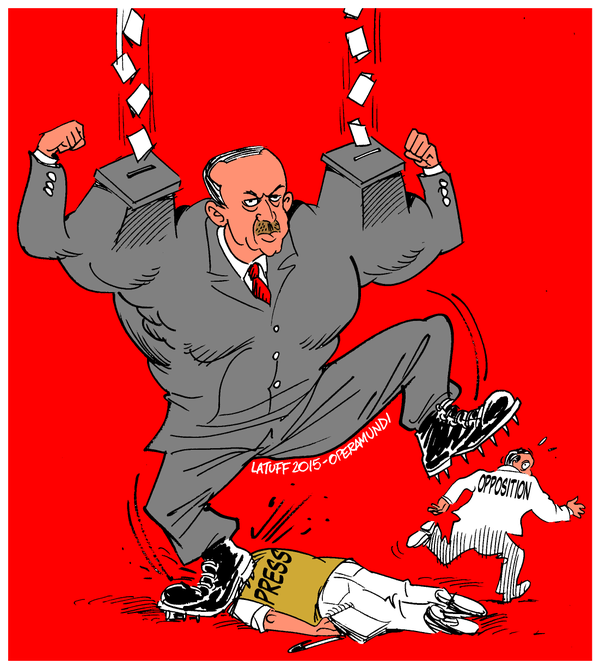
Hopefully the US will wake up to the fact that Erdogan's political games - last years coup, his turn around with Russia, locking up of all opposition and press, Syrian involvement and now his spat with the Netherlands, are all focused on one objective - obtaining absolute power in Turkey. 

In the meantime he has also become an unreliable NATO partner as a result of hisflirtatations with Russia. 

Whoever is not aware of this is either extremely shortsighted or totally stupid. 

All of us in the EU are wishing Mrs. Merkel  a very successful  and productive US visit.

Sunday, March 12, 2017

Turkey’s Tyrannical Rule, Erdogan’s “Democratic Dictatorship” - by Stephen Lendman

The Boss is a dictator - vote NO
Anyone criticizing or challenging his leadership risks imprisonment, including public figures, journalists, academics, other intellectuals, human rights activists, even young children – on charges ranging from insulting the president to terrorism, espionage or treason.

He purged or imprisoned over 100,000 regime critics – from the judiciary, military, police, media and academia.

His state of emergency imposed after last summer’s coup attempt “target(s) criticism, not terrorism,” according to UN High Commissioner for human rights, Zeid Ra’ad al-Hussein.

He uses emergency powers to target dissent, aimed at consolidating unchallenged power.

He’s accused of disappearing opponents, extrajudicial killings, torture, and other flagrant human rights abuses.

Last year, he cited Hitler as a role model, calling his Nazi regime perhaps an ideal way to run Turkey, saying he wants things streamlined for more effective decision-making – code language for wanting iron-fisted rule, all challengers and critics eliminated.

He’s at war with Kurds in Turkey, Syria and Iraq, committing atrocities on the phony pretext of combating terrorism he supports – claiming he has a “historical (regional) responsibility.”

A row between Berlin and Ankara erupted after local German authorities cancelled campaign events Turkish ministers arranged to speak at in support of an April referendum on expanding Erdogan’s presidential powers.

About 1.4 million Turkish nationals live in Germany, eligible to vote in the referendum.

Chancellor Angela Merkel said she had nothing to do with it. Ignoring his own tyrannical rule, Erdogan responded angrily, saying “Germany, you have no relation whatsoever to democracy and you should know that your current actions are no different to those of the Nazi period.”

His spokesman Ibrahim Kalin claimed “(a) huge anti-Turkey, anti-Erdogan attitude is being systematically produced and serviced to the world, especially through Germany.”

Merkel said his accusations “cannot be justified. We will not allow the victims of the Nazis to be trivialized. These comparisons with the Nazis must stop.”

Last month, Die Welt reporter Deniz Yucel, with dual German/Turkish citizenship, was detained in Istanbul, accused of spying for Berlin and representing the outlawed Kurdish PKK group.

Germany called the charges “absurd.” Merkel told parliament her government is working “with all its means” to free him.

A separate row erupted after the Netherlands canceled flight clearance for Turkish Prime Minister Melvut Cavusoglu’s scheduled March 11 visit to Rotterdam to speak at a pro-Erdogan rally.

Dutch Prime Minister Mark Rutte said Ankara wasn’t respecting public gathering rules, explaining:

    “Many Dutch people with a Turkish background are authorized to vote in the referendum over the Turkish constitution. The Dutch government does not have any protest against gatherings in our country to inform them about it.”

    “But these gatherings may not contribute to tensions in our society and everyone who wants to hold a gathering is obliged to follow instructions of those in authority so that public order and safety can be guaranteed.”

Cavusoglu angrily responded, saying “(i)f the Netherlands cancels my flight clearance today, then we will impose severe sanctions,” adding he intends flying to the country later on Saturday.

A Dutch government statement said his “sanctions threat made search for a reasonable solution impossible.”

Erdogan called Dutch authorities “Nazi remnants, fascists,” warning they’ll be impeded from traveling to Turkey.

How this row gets resolved remains to be seen. Dealings with Erdogan are never easy.

Note EU-Digest: Turkey under leadership of Erdogan is an ever increasing disaster: It is time for the EU, the NATO and democratic countries around the world to call a Spade a Spade and wake up to the fact that it is impossible to deal with this Turkish narcissist president. 

He already is a dictator - has no respect for the present Turkish Constitution, election laws (which forbid the Turkish Government and citizens to hold political rallies abroad); locked up more journalists than China; and has enriched himself and his family with money from illegal business deals .Erdogan's so-called referendum on April 16, 2017 is nothing more than a further attempt to amass more power and influence.. YES INDEED, TURKS AROUND THE WORLD NEED TO PROTECT TURKEY FROM DESTRUCTION AND VOTE NO.

Read more: Turkey’s Tyrannical Rule, Erdogan’s “Democratic Dictatorship” | Global Research - Centre for Research on Globalization

Saturday, March 11, 2017

Turkey-The Netherlands -EU: Diplomatic row as Dutch withdraw landing rights for Turkish minister's plane

The Netherlands says NO
The Netherlands has withdrawn landing rights for a plane carrying a Turkish government minister who wanted to address a rally in support of a controversial referendum giving more power to the president.

Foreign affairs minister Mevlüt Cavusoglu was planning to speak at a meeting in support of the referendum in Rotterdam late on Saturday afternoon. The decision to stop the plane carrying Cavusoglu from landing was taken on public order grounds. The call by the Turkish authorities for a mass demonstration is a threat to public order and safety, the Dutch foreign affairs ministry said in a statement.

‘The Netherlands was in talks with the Turkish authorities about an acceptable solution to the visit,’ the statement said. Talks were ongoing about whether the meeting could take place in a smaller, closed environment such as a Turkish consulate or the embassy. ‘But before those talks could be completed, the Turkish authorities made a public threat about sanctions.

That made the search for a reasonable solution impossible,’ the statement said. The ministry said that many Dutch Turkish have voting rights in Turkey and that the government has no objection to information meetings. ‘But these meetings cannot contribute to the tensions in our society,’ the statement said.

More powers Cavusoglu hopes to win support for a yes vote in the Turkish referendum on amending the constitution to concentrate more power with president Tayyip Erdogan. Prime minister Mark Rutte has said the visit, planned for just four days before the Dutch general election, is ‘undesirable’.

The timing is inopportune, given that much of the election campaign revolves around maintaining the Dutch identity. It would also be playing into the hands of Geert Wilders, who held a short demonstration for the press in front of the Turkish embassy on Wednesday, Dutch commentators said.

Note EU-Digest: Obviously this move by the Dutch PM will score a lot of points for him in the upcoming Dutch elections in 4 days ,


Read more: Diplomatic row as Dutch withdraw landing rights for Turkish minister's plane - DutchNews.nl

Friday, March 10, 2017

Germany: Merkel set to have her most awkward American experience – with Trump

She told the German Parliament that Europe “must be able to have an independent crisis management in our region” — not in competition, but in addition to NATO.

The “trans-Atlantic partnership based upon our values and interests” is of overriding importance for Europeans — and that “this is the spirit” in which she would lead her talks with Trump in Washington.

Indirectly referring to Trump’s isolationist economic leanings, she said “even if in parts of the world we see protectionist and nationalist approaches on the rise, Europe may never isolate, seal itself off or withdraw.”

Trump has vowed to take a tougher line in forging deals and slapping a border tax of 35 percent on cars that German carmaker BMW plans to build at a new plant in Mexico and export to the United States.

But the Germans are willing to call it a bluff. “Do we really want to try to force German citizens to buy American cars?” says, Jürgen Hardt, the Berlin’s coordinator for transatlantic policies.

“Does the American president want to force Americans to stop buying German cars in the future? Do we want to artificially make German cars more expensive with taxes so that consumers buy more foreign products?”

Asked about the future of transatlantic trade, a senior administration official on Friday said the White House has “not formulated a final position” on whether it will pursue the Transatlantic Trade and Investment Partnership (T-TIP) deal with the European Union.

On defense and security policy, Trump has been “heartened” by what he has heard from Berlin about devoting more resources to the annual NATO military budget, according to the senior official.

Germany spends less than 1.2 per cent of its gross domestic product on defense, compared with a NATO target of 2 per cent. Trump wants this to change, and Berlin has pledged to meet the NATO target by the mid-2020s.

Trump intends to talk with Merkel about her government crafting a “concrete plan,” the senior official said.

Read more: Merkel set to have her most awkward American experience – with Trump | Euronews

Thursday, March 9, 2017

EU-China Relations: How Trump May Drive EU and China Closer on Trade: QuickTake Q&A - by Dara Doyle

The European Union and China may be moving toward closer trading ties as President Donald Trump introduces an element of uncertainty into the U.S.’s trading relationship with the rest of the world. Some EU leaders have been encouraged by Chinese President Xi Jinping’s push back against Trump’s protectionist rhetoric. Though China still goes to great lengths to protect its domestic industries -- just one of the issues that divides the two sides -- some believe the time is right to seal an EU-China accord. It would be a milestone for two of the most powerful players in world trade.

The European Union and China may be moving toward closer trading ties as President Donald Trump introduces an element of uncertainty into the U.S.’s trading relationship with the rest of the world. Some EU leaders have been encouraged by Chinese President Xi Jinping’s push back against Trump’s protectionist rhetoric. Though China still goes to great lengths to protect its domestic industries -- just one of the issues that divides the two sides -- some believe the time is right to seal an EU-China accord. It would be a milestone for two of the most powerful players in world trade.

1. How is Trump pushing the EU and China closer?

German Chancellor Angela Merkel has spoken about her concern with the rise of protectionism, while Chinese President Xi has likened protectionism to “locking oneself in a dark room.” Jyrki Katainen, a vice president of the European Commission, the EU’s executive arm, has predicted the relationship between Europe and China will deepen. Trump withdrew the U.S. from the 12-nation Trans-Pacific Partnership and is likely to end talks on a similar open-trade deal with the EU. That all leaves the EU and China freer to maneuver.

2. What could result from closer ties?

China and the EU are working on an agreement to liberalize investment and eliminate restrictions on investors in each other’s market. Katainen said Europe wants to speed up those talks. Currently, the EU accounts for about 16 percent of investment flows into China.

3. How much trading goes on now?

A lot. China is the EU’s second-biggest trading partner after the U.S.; the EU is China’s biggest trading partner. More than 1.5 billion euros ($1.6 billion) of goods and services move between China and the EU daily. That amounts to more than 500 billion euros a year. In all, China accounts for about 20 percent of EU goods imports and 10 percent of its exports.

4. Who has the edge on trade?

In 2015, the EU ran a trade deficit in goods of 180 billion euros with China. In services, the EU had a surplus of 10.9 billion euros.

5. Is the EU OK with that trade imbalance?

Not at all, which has made the EU’s relationship with China rocky. The trade deficit is at least partly due to barriers China has thrown up. In a laundry list laid out by EU Trade Commissioner Cecilia Malmstrom, these include non-tariff measures that discriminate against foreign companies, Chinese government support for state-owned competitors and poor protection of intellectual-property rights. Malmstrom says China’s Jinping needs to follow his words with action on free trade and globalization.

6. What does Europe want?

In a word, reciprocity. European companies want the same level of access to China that the EU gives to Chinese firms. The Chinese have made high-profile purchases in Europe, including German airports, the Port of Piraeus in Greece and Italy’s Pirelli & C. SpA. By contrast, European investors face barriers, including equity caps, forced technology transfers and licensing restrictions, Malmstrom said. European steelmakers must also compete with Chinese firms that benefit from huge subsidies, she said, adding that Chinese firms are treated impartially by European regulators but that isn’t always the case for European companies in China.

7. How has the EU reacted to these barriers?

In the last three months of 2016 alone, the EU expanded tariffs on steel pipe from China, imposed anti-dumping duties as high as 74 percent on two other types of Chinese steel and laid out plans to extend tariffs on imported Chinese solar modules for another two years. In all, China faces more European anti-dumping duties than any other country.

8. What does China say about all this?

It complains it’s being treated like a non-market economy -- meaning, the EU uses other nations’ trade and manufacturing figures to calculate anti-dumping levies against China. The EU says it does this because China’s subsidies distort the market by artificially lowering domestic prices, making them an unreliable indicator of a good’s “normal value.”

9. Is that allowed?

 It’s up for debate. Under World Trade Organization rules, countries may consider a product to be dumped when it’s sold abroad at less than normal value. For the past 15 years, the WTO has allowed the EU to use “analogue” figures -- prices and costs from other countries -- when it calculates whether China is dumping products into Europe. This has made it easier for the EU to levy duties on Chinese imports. China filed a WTO complaint that, if successful, could prod the EU into relying on Chinese-provided costs and prices. That could reduce the EU’s ability to protect its domestic industries. The EU is proposing to scrap its analogue methods to meet Chinese demands while pledging other tweaks that it says would ensure European anti-dumping duties continue to protect against state intervention in China.

10. What happens next?

Chinese Premier Li Keqiang has accepted Merkel’s invitation to visit Germany for talks on economic and trade issues. No date has been set.

Read more: How Trump May Drive EU and China Closer on Trade: QuickTake Q&A - Bloomberg

Wednesday, March 8, 2017

US Economy: Economic growth expectations are quietly falling through the floor - by Jeff Cox

Those looking for a rapid uptick in the U.S. economy probably will have to tone down their expectations, at least for now.

In the near term, growth projections, at least by the top-line measurement of gross domestic product, are looking a whole lot more tepid than they did a few months ago.

GDP, which measures the sum of goods and services in the economy, is likely to have increased just 1.2 percent in the first quarter, according to the Atlanta Fed's closely watched GDPNow model. That's below the 1.5 percent projected by CNBC's Rapid Update forecast.

While much of the market has been focused on increased growth expectations under the Trump administration, GDP numbers have been sinking rapidly, in a precipitous though somewhat stealthy manner.

As recently as Feb. 3, the Atlanta Fed was projecting 2.7 percent growth for the first three months of 2017. But a steady flow of disappointing numbers, from production to construction spending to trade, has pulled down the estimate.

Those numbers have stood in stark contrast to sentiment surveys from businesses, investors and consumers, as well as purchasing managers and others at the corporate forefront. That in turn has produced some severe head-scratching from market professionals.

Read more: Economic growth expectations are quietly falling through the floor

Turkey has stepped up spying in Germany, says Berlin

Erdogan Dictatorship Referendum
Turkey has stepped up spying in Germany, says Berlin

Amid ongoing diplomatic unrest, German intelligence has reported an increase in Turkish spying in Germany. Turkey's Foreign Minister meanwhile has said Berlin "must decide whether Germany is a friend or not."

Read more: Symbolbild NSU Affäre Verfassungsschutz Jahrestag Terrorismus Rechtsradikale (picture-alliance/dpa)   

While tensions between Berlin and Ankara have escalated ahead of next month's referendum on Turkey's presidency, the German government said on Wednesday that there has been a significant increase in Turkish spying in Germany.

Germany's domestic intelligence agency, the BfV, said divisions in Turkey leading up to the controversial April 16 referendum on boosting the powers of President Recep Tayyip Erdogan were mirrored in Germany.

"The BfV is observing a significant increase in intelligence efforts by Turkey in Germany," it said in a statement. No further details were provided.

Already strained relations between Germany and Turkey reached a new low this month in a row over canceled Turkish political rallies to drum up support for the impending referendum.

Some 1.4 million Turks living in Germany are eligible to cast their ballot in the vote.

Hoping to calm the storm on Wednesday, German Foreign Minister Sigmar Gabriel met with his Turkish counterpart Melvut Cavusoglu in Berlin. While both diplomats agreed on the importance of good relations, Cavusoglu said that Germany must now "decide whether Turkey is a friend or not."

In light of recent comments from both Cavusoglu and Erdogan, Gabriel also made it clear that in maintaining good relations "there are lines that should not be crossed."

"...And one of those is the comparison with Nazi Germany," Gabriel said.

Cavusoglu, meanwhile, said he would host Gabriel for a new round of talks in Turkey "as soon as possible."

In a bid to secure support ahead of next month's referendum, Erdogan himself is also due to hold a rally in Germany. Critics have warned, however that the proposed presidential system which seeks to expand Erdogan's powers as president would cement a one-man rule in the country.

Read more: Turkey has stepped up spying in Germany, says Berlin | News | DW.COM | 08.03.2017