The halt to the 18-month ban on travel from 33 countries, including members of the European Union, China, Iran, South Africa, Brazil and India, could help rejuvenate a U.S. tourism industry that has been crippled by the pandemic. The industry suffered a $500 billion loss in travel expenditures in 2020, according to the U.S. Travel Association, a trade group that promotes travel to and within the United States.
Foreign travelers will need to show proof of vaccination before boarding and a negative coronavirus test within three days of coming to the United States, Jeffrey D. Zients, the White House pandemic coordinator, said on Monday. Unvaccinated Americans who want to travel home from overseas will have to clear stricter testing requirements. They will need to test negative for the coronavirus one day before traveling to the United States and show proof that they have bought a test to take after arriving in the United States, Mr. Zients said.
Read more at:
U.S. to Lift Pandemic Travel Restrictions, Easing Tension With Europe - The New York Times
Showing posts with label Travel Ban. Show all posts
Showing posts with label Travel Ban. Show all posts
Thursday, September 23, 2021
Saturday, March 28, 2020
U.S.-Europe Travel Ban: The Most Impacted Airlines, Countries And Airport Hubs In Trump’s Fight Against Coronavirus - by Will Horton
viation’s most important international market, travel between Europe
and North America, will be severely impacted, at least in the
short-term, from U.S. President Donald Trump’s announcement of a 30-day restriction on travel between the U.S. and most of Europe. The measure is an effort to limit the spread of coronavirus in the U.S.
The restriction applies to foreign nationals who, within the last 14 days, have been to one of the 26 countries in the Schengen Area, a European bloc with open border agreements. The United Kingdom and Ireland are not part of Schengen, and are so far excluded from the restrictions. There was initial confusion of the details due to conflicting information between President Trump, his aides and other government departments.
 U.S. citizens, and others with exemptions, can continue travel but
will be re-directed through certain U.S. airports, as has been done for
passengers from Mainland China and Iran.
U.S. citizens, and others with exemptions, can continue travel but
will be re-directed through certain U.S. airports, as has been done for
passengers from Mainland China and Iran.
Aviation will be directly impacted from passengers unable to travel, and indirectly affected as the travel restriction sends negative connotations and sees consumers lose market confidence.
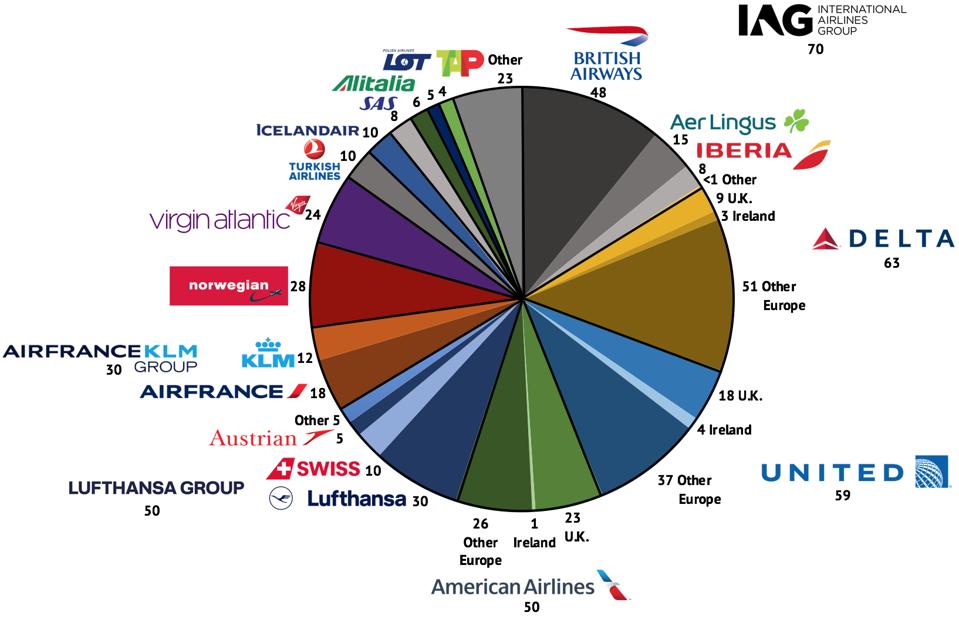
The situation is dynamic, in its early days, and difficult to precisely predict. Airlines were already taking different measures on trans-Atlantic flight capacity with changes being rolled out or evaluated in headquarters. The flow of passengers between the U.S. and Europe is not easily delineated. Europe’s strong international airlines and airport hubs mean that Ireland and the U.K., exempt from the ban, will be impacted as passengers use those countries to connect between the U.S. and other European destinations. The Netherlands, which is covered in the ban, has passengers transfer between the U.K. and U.S. Canada is also a hub.
Countries most impacted: Germany, France and Netherlands. The U.K., which is exempt from the ban, is the single largest European market from the U.S., accounting for 31% of flights – 137 a day carrying 31,000 passengers in April 2019. This is almost as big as the next three largest countries combined: Germany (13%), France (11%), and the Netherlands (9%) for a total of 33% or 143 flights a day carrying 35,000 passengers.
The ban directly impacts 266 daily flights from Europe to the U.S. Indirect impacts will affect 173 other daily flights to the U.S. from European countries not covered by the ban, mainly the U.K. as well as Ireland, which had 5-6% of flights and passengers.
Read more at: U.S.-Europe Travel Ban: The Most Impacted Airlines, Countries And Airport Hubs In Trump’s Fight Against Coronavirus
The restriction applies to foreign nationals who, within the last 14 days, have been to one of the 26 countries in the Schengen Area, a European bloc with open border agreements. The United Kingdom and Ireland are not part of Schengen, and are so far excluded from the restrictions. There was initial confusion of the details due to conflicting information between President Trump, his aides and other government departments.
U.S. citizens, and others with exemptions, can continue travel but
will be re-directed through certain U.S. airports, as has been done for
passengers from Mainland China and Iran.Aviation will be directly impacted from passengers unable to travel, and indirectly affected as the travel restriction sends negative connotations and sees consumers lose market confidence.
The situation is dynamic, in its early days, and difficult to precisely predict. Airlines were already taking different measures on trans-Atlantic flight capacity with changes being rolled out or evaluated in headquarters. The flow of passengers between the U.S. and Europe is not easily delineated. Europe’s strong international airlines and airport hubs mean that Ireland and the U.K., exempt from the ban, will be impacted as passengers use those countries to connect between the U.S. and other European destinations. The Netherlands, which is covered in the ban, has passengers transfer between the U.K. and U.S. Canada is also a hub.
Countries most impacted: Germany, France and Netherlands. The U.K., which is exempt from the ban, is the single largest European market from the U.S., accounting for 31% of flights – 137 a day carrying 31,000 passengers in April 2019. This is almost as big as the next three largest countries combined: Germany (13%), France (11%), and the Netherlands (9%) for a total of 33% or 143 flights a day carrying 35,000 passengers.
The ban directly impacts 266 daily flights from Europe to the U.S. Indirect impacts will affect 173 other daily flights to the U.S. from European countries not covered by the ban, mainly the U.K. as well as Ireland, which had 5-6% of flights and passengers.
Read more at: U.S.-Europe Travel Ban: The Most Impacted Airlines, Countries And Airport Hubs In Trump’s Fight Against Coronavirus

Subscribe to:
Posts (Atom)