ANNUAL ADVERTISING RATES FOR INSURE-DIGEST

Annual Advertisement Rates
Showing posts with label Tourism. Show all posts

Thursday, June 18, 2020

Italy's tourism industry braces for 'worst revenue slump in over 20 years'

The country, which welcomed over 60 million foreign tourists in 2018, according to the World Tourism Organization, is now expecting 56 million fewer overnight stays, according to a new survey from Florence's Centrefor Tourism Studies.

Read more at:
Italy's tourism industry braces for 'worst revenue slump in over 20 years' - The Local

Tuesday, May 12, 2020

Spain, France ease coronavirus restrictions

Spain and France both took steps Monday to loosen the tight restrictions that the countries imposed to try to control the spread of the coronavirus pandemic.

In Seville, Spain, waiters in face masks served coffees and "bocadillo" sandwiches at café terraces as parts of the country eased restrictions while the number of new fatalities dropped to a near two-month low.

Sunday, March 15, 2020

US Economy: Area Convention and Visitors Bureau paints bleak picture on virus' economic impact

 Over 350 teams and 10,000 spectators were supposed to be filling 29 different Springfield gyms this week for the Home School National Basketball Tournament.

But as with many other events, the tourney was cancelled because of the coronavirus threat. Tim Flatt, the Executive Director of the Home School National Tournament, said it was not an easy decision as tourney officials had to weigh the health concerns against the cherished memories for fans and players that would never be realized if the games weren't played.

"The parents think we made a great decision but the kids are heartbroken," Flatt said. "The last thing we wanted to do though was be responsible for bringing the virus to this area. We love Springfield.

We love the leadership and the friendliness of the people and we want to keep a long-term relationship here."

The emotional toll is not the only problem developing though.

According to officials with the Springfield Convention and Visitors Bureau and the Sports Commission, the economic impact from losing the tournament effects everything from the city's potential gas and food revenue to over 7,000 room-nights at local hotels that are lost.

So now the tourism industry will have to wait and see how bad things get.

"I've never seen anything like it," Kimberlin said. "And I hope I never see anything like it again."

"How's this all going to play out?" Kettering added. "It's just uncharted territory."

Read more at: Area Convention and Visitors Bureau paints bleak picture on virus' economic impact

Thursday, November 21, 2019

Tourism: Spain set for tourism record as U.S. visitors counter Brexit blues

Spain is on track for a record year of tourist arrivals, the seventh straight year of new highs, with U.S. and Asian visitors countering the disruption of Brexit and collapse of tour operator Thomas Cook, the industry minister said on Wednesday.

Read more at:
https://uk.reuters.com/article/uk-spain-economy-tourism/spain-set-for-tourism-record-as-u-s-visitors-counter-brexit-blues-idUKKBN1XU20E


Sunday, August 4, 2019

USA: Tourists Beware - US Still Cowboy Country: Mass shootings past 24 hrs kill 30 people in Texas and Ohio

Tourism USA - Still No Gun Control ?
This year alone, there have been at least 32 fatal shootings in America,

Mass shootings in El Paso Texas, and Dayton Ohio. If I was a tourist deciding if I would go on vacation to America, and heard that 29 people were killed within 24 hrs today, in addition to the non-stop gun violence all around the country, and knowing the US has no real gun control laws which work, I would certainly think twice, before I would go to the US on vacation.

Statistics are also showing that the U.S. tourismvhas suffered heavily since 2016. Now it looks like the evidence is finally here.

The bigger picture shows the U.S.is specially  losing ground on the global stage. Arrivals to Europe and Asia-Pacific both increased by 6 percent, while the Middle East saw a 10 percent uptick in 2018. It seems that global travelers are looking elsewhere for their vacations.

“International travel markets posted disparate performance in 2018 including several notable surprises on the downside,” states the report from Tourism Economics.

“After registering average annual growth of 23 percent over the previous decade, Chinese travel to the US stopped in its tracks last year—perhaps in connection to trade tensions. Similarly, South Korea fell 3 percent after averaging 11 percent growth over the prior ten years. Japan also contracted; this continues the narrative of an ever important but languishing market. And Germany surprised with a steep decline in 2018, perhaps evidence of a reaction to unpopular U.S. diplomacy and policies.”

Among some of the major reasons foreign tourists are giving for not choosing the US as their tourist destination  are: inadequate Public Transportation Systens, personal safety, as a result of gun violence and poor infrastructure.

EU-Digest

The Digest  Group
Almere-Digest
EU-Digest
Insure-Digest 
Turkish-Digest 

For additional information, including advertising rates - e-mail:Freeplanet@protonmail.com  

Thursday, June 20, 2019

Global Tourism: while some cities around the world want more tourist, many don't

Tourist overload: Some world destinations want more visitors - and some really, really don't.

Read more at: 
The Digest Group                   
Almere-Digest
EU-Digest
Insure-Digest 
Turkish-Digest 

For additional information, including advertising rates:
e-mail:  Freeplanet@protonmail.com freeplanet@protonmail.com

Wednesday, January 16, 2019

US Government Shutdown: hurting tourist industry - travel implications

Intl. tourists starting to avoid
 visiting US following Govt, shutdown
Not only in the US, but also in bordering countries, the multi million tourist industry is starting to hurt from the Trump Administration government shutdown.

In the Bahamas local business owners warily eye the Trump U.S. government shut down and any potential impact on the tourism industry, fearing a continuation that could lead to a drop in visitor arrivals to the Bahamas, as around 800,000 federal employees await pay.

With the shutdown entering its 26thth day and Friday marking the first missed pay period for these workers across the United States, planning future trips to The Bahamas will be the last thing on their minds.

Similar situations can be seen in Mexico and Canada, which usually attract a lot of US tourists throughout the year.

As the lock-down continues, travelers and tourists visiting the US  are also dwindling.

International Airlines around the world are advising their customers traveling to the U.S. that they arrive at airports at least three hours prior to their scheduled departure time, due to increased processing times and other delays and many tourists have cancelled plans to visit the US.

Airline pilots tell @RealDonaldTrump that the #shutdown is jeopardizing national security — air marshals, TSA, air traffic controllers and more.

The largest association of pilots in the US has also expressed concerns over the safety of the nation’s airspace which it said was being threatened due to the shutdown.

There has not been a blanket order yet to clos,  but National Parks across the US are struggling to remain open without funding to pay rangers. Without staff at the gates, parks are also losing a reported $400,000 a day in entry fees. Many campgrounds and walking trails have had to close due to a build-up of litter and other sanitation issues.

Bottom-line: at this point in time, international and local tourists probably should think twice before planning a trips to and in the US.
 

Wednesday, November 14, 2018

Sunday, October 22, 2017

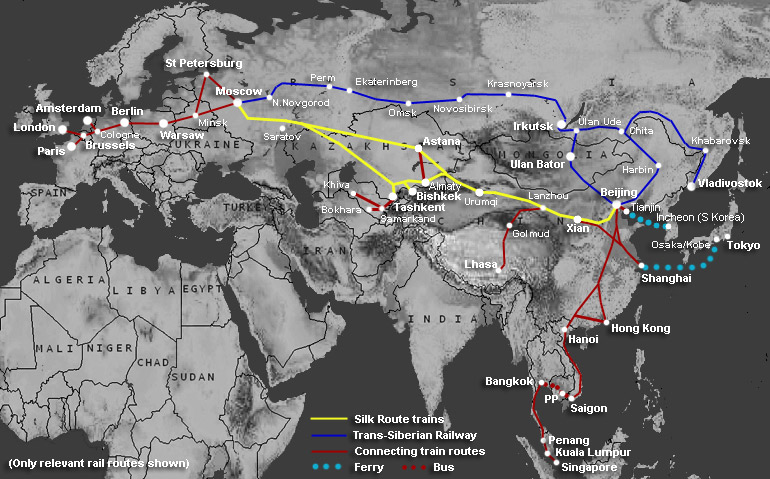
Go by Rail to Asia: New rail routes between China and Europe will change trade & tourism patterns


Route map - The Silk Route & Central Asia by trainASTANA in Kazakhstan is one of the world’s most remote capitals, surrounded by thousands of kilometres of empty steppe. This summer Astana attempted to launch itself onto the global stage by hosting the World Expo, which closed on September 10th and underwhelmed many attendees. But there are other ways to have an impact. On the city’s north side, away from the Expo’s exhibits, a series of diesel trains, each pulling dozens of containers, roll through the old railway station. Most are heading from China to Europe. Last year over 500,000 tonnes of freight went by train between the two, up from next to nothing before 2013. Airlines and shipping firms are watching things closely.

The trains rumbling through Astana result from a Chinese initiative, in tandem with countries like Kazakhstan, to build a “New Silk Road” through Central Asia. The earlier overland routes were once the conduits for most trade between Europe and China and India; they faded into irrelevance when European ships started circumnavigating the Cape of Good Hope.

China has long wanted to develop its inland regions and push industry to “go west”, in order to spread economic growth more evenly. Manufacturers have been loth to shift, in part because of the higher cost of moving goods to ports for export. Developing a rail-freight network to Europe—an important part of China’s “One Belt One Road” policy—opens up a new route to market for its poorest areas. The land route through Central Asia is relatively short. A container ship too large for the Suez canal must make a 24,000km journey to reach Europe. Trains travel no more than 11,000km to reach the same destination.

Kazakhstan has spent over 1.1trn tenge ($3.2bn) on upgrading its railway lines and rolling stock since 2011. That includes $250m on the Khorgos Gateway, a dry port at the border with China that lifts containers from Chinese trains onto Kazakh ones to overcome a change in track width (a problem that has stymied previous efforts to build railway routes between Europe and China).

Volumes of freight travelling between China and Europe by rail are rising quickly. Between 2013 and 2016 cargo traffic quintupled in weight. In the first half of this year the value of goods travelling by train rose by 144% compared with the same period in 2016. Western firms have been keen to embrace rail freight because it helps them to lower costs, says Ronald Kleijwegt, an expert on the industry. In the case of high-tech electronics, for example, which consumers like to receive quickly, making them on China’s coast and air-freighting them to Europe is extremely pricey.

How worried should shipping firms and airlines be? Kazakhstan’s national rail company, KTZ, says it will have capacity for 1.7m containers to pass through the country between Europe and China each year by 2020; that is a tenth of the volume currently carried by sea and air between the two. In the longer term, a full modernisation of the existing main three rail routes from China to Europe could produce 3m containers a year in capacity.

But there are also reasons to doubt that will happen. For one thing, China plans to stop handing out government subsidies for additional rail-freight capacity from 2020, which will slow the network’s expansion. Sea freight has little to fear in the near term, says Soren Skou, chief executive of Maersk, the world’s biggest container-shipping line. Trains may take away some future growth from ships, he concedes, but not their existing business.

Air cargo is more vulnerable. Last year, 180,000 tonnes of cargo travelled on trains to western Europe from China (the remainder was destined for Russia and eastern Europe). That is a small fraction of the 52m tonnes that came by sea, but a big chunk of the 700,000 tonnes that came by air. Much of that air cargo could switch to rail in future, says Mr Kleijwegt, with one important proviso—that Russia would need to lift the retaliatory sanctions it placed in 2014 on imports of Western food, which stop most foodstuffs from traveling by land between Europe and China. That is unlikely for the time being. But it was only a decade ago that people thought the idea of freight trains between Europe and China was a joke, says Mr Kleijwegt—and no one laughs at that any more.

Read more: New rail routes between China and Europe will change trade patterns

Friday, August 25, 2017

European Railways: Why interrailing as an adult is the best way to explore Europe - by Chris Beanland

Interrailing should be a compulsory teenage rite of passage – no wonder the EU recently floated the idea of giving out free passes to all 18-year-olds. What better way to protect this beautiful, but fragile union than by showing the next generation what they have in common with each other and how many hi-jinks they can get up to in neighbouring European countries?

It was my first taste of independent travel too – 17 summers ago, though it seems like yesterday. Back then it was a Karrimor loaded with band T shirts, Lonely Planet Europe On A Shoestring and bank robber sacks of change for telephone boxes. This time, instead of sleeping cars, hostels and that tangy scent of socks, there were nice hotels and the scent of understated luxury. Three’s Feel At Home free roaming contract and my iPhone brought the whole experience into the 21st century, and meant home was only the touch of a button away.

It was a cultural whip round the first time, but it was also a piss up – getting out of your tree being the sine qua non of teenage travelling – that resulted in lost cash cards, nearly getting into fights on night trains and passing out on deck chairs on Positano Beach. And I met so many people – this was social networking avant la lettre, coming across fellow flaneurs from Australia, Canada, Finland, and making firm friends, if not for life then at least for a night.

Interrailing as an adult was much more relaxed and even more cultured, with less boozing and earlier mornings. I sped through Rotterdam’s Docklands on a watertaxi, climbed all over Tomas Saraceno’s incredible spiderweb netting art installation five floors above the ground of Dusseldorf’s Modern Art Gallery, had a sneak preview of some of the exhibits at Kassel’s famous art festival, Documenta (documenta.com), saw Eileen Gray furniture at Munich’s Design Museum, drank at Wes Anderson’s Bar Luce in Milan’s Fondazione Prada, and explored Novi Belgrade’s mind-blowing brutalist architecture.

The food was better this time around too. Back in 2000 I had inadvertently explored the premise “how can a human function on pizza alone for three weeks?” shortly after enduring the very worst meal of my entire life (do not ever accidentally order the minced heart and lung soup at Worgl station buffet).

This time I ate mushroom arancini with a vegetable mayonnaise in an old swimming pool in Rotterdam (alohabar.nl) and fresh white asparagus at the BMW Welt’s restaurant. Even the train food was good – on Deutsche Bahn’s ICE I chowed down on lamb kofte with yoghurt and mashed carrots in the Bordrestaurant.

Read more: Why interrailing as an adult is the best way to explore Europe | The Independent

Saturday, August 19, 2017

Kazakhstan: EXPO-2017 in Astana, Kazakhstan, is worth a visit

Kazakhsta Capital Astana is a modern and friendly city
After a build-up lasting five years, Kazakhstan has finally opened EXPO-2017. If you’re in Astana between now and mid-September when it closes, you should go.

It might feel excessively corporate and you’ll probably come out of the EXPO-2017 site none-the-wiser on what exactly its Orwellian-tinged ‘Future Energy’ means, but don’t dwell on this — it’s not the real point of the exposition.

In reality it is putting Kazakhsta on the map for many people and they will be very positively surprised.

EXPO-2017 is a source of national pride and a must-do event for most ordinary Kazakhs this summer, at least for the ones who live in and around Astana.

And this pride and sense of fun is evident throughout EXPO-2017. The dozens and dozens of uniformed guides are courteous, speak excellent English and are genuinely helpful. The student volunteers beam with joy and are relishing the internationalism of the whole event.

As for the visitors, at the beginning of the expo it must have been 95% Kazakh. These were groups of families and friends touring the pavilion, drinking in each country’s take on EXPO-2017. This ranges from Britain’s glowing yurt to Iran’s focus on promoting its carpets.

The visiting Kazakhs, armed with selfie sticks and aging smartphones, weren’t the super rich who travel effortlessly around the world, these were Kazakhs who may never have left Central Asia, or been on a solitary trip to Europe. EXPO-2017 feels as if it has returned the international exposition series to its original mid-19th century Victorian era roots of bringing the world to a particular city.

And make sure you don’t miss out on the Caribbean pavilion, the least scripted section. The women from Belize, Haiti and Dominica will tell you how they are coping with four months in Kazakhstan, a country they hadn’t heard of until earlier this year.

Many Airlines are flying into  Kazakhstan with some special fares of less than euro 100.00 rt.. including:
 
Lufthansa flightsUkraine International flightsPegasus Airlines flights
Aeroflot flightsEtihad Airways flightsTurkmenistan Airlines flights
Air France flightsAir India flightsHainan Airlines flights
S7 Airlines flightsAtlasglobal flightsUzbekistan Airways flights


FOR ADDITIONAL INFORMATION ON ON KAZAKHSTAN CLICK HERE

EU-DIGEST

Monday, April 3, 2017

Tourism: U.S. To Lose $1.6B As Mexican Vacationers Choose Canada- by Alexandra Talty

The American tourism industry could be facing a new phenomena: waning interest in the traveling to the United States.

After decades of sitting pretty as a bucket list destination, the stars and stripes might be on their way out. Experts warn that anti-immigration rhetoric as well as confusing travel and electronic bans have dampened foreign interest in U.S. vacations, especially from Mexico.

"We have Twitter wars with our President and former President of Mexico… There is lots of speculation in the media about a trade war with Mexico," says Douglas Quimby, of Phocuswright, a travel research firm. "If that happens, what kind of impact does that have on millions of middle class Mexicans looking to take a trip?"

Mexican sentiment for the U.S. has been lagging since the primary elections when then-incumbent Donald Trump claimed that Mexican immigrants were rapists and drug dealers. There were reports of Trump piñatas, angry newspaper op-eds and anti-Trump murals. During the presidential debate, Mexicans held drinking games, knocking one back every time their country was mentioned.

At the same time, Canada has made it easier than ever to visit. In June 2016, Canadian Prime Minister Justin Trudeau announced visa-free travel for Mexicans. Since the policy was first announced, Mexican tourism to Canada has been skyrocketing, increasing 16%, according to ForwardKeys, a travel trend predicting firm.

Read more: U.S. To Lose $1.6B As Mexican Vacationers Choose Canada

Wednesday, October 12, 2016

Security alert: Map of the most dangerous countries for tourists to visit

The UK Foreign and Commonwealth Office (FCO) updated its travel advice for Turkey after recently  three suicide bombers killed 45 people at Atatürk International Airport in Istanbul.
 
The government body now advises against all travel to within 10 kilometres of the border with Syria and to the city of Diyarbakir, while all but essential travel to the surrounding south-east of the country should be avoided.
 
A new map, which we first spotted on Indy 100, uses the FCO's information to illustrate which countries in the world are considered safe to visit and where caution should be exercised.

The map is colour coded.

Click here to See the Map of the most dangerous countries for tourists to visit - Business Insider

Friday, March 25, 2016

Turkey: Tourist Industry: Turkish tourism sector expects $12 bln loss in revenue - by Erdal Sağlam

Istanbul -European side Bosphorus
Tourism representatives have said 2016 has been “much worse” than the predicted “worst case scenario,” noting the revenue loss in the sector would likely surge to $12 billion over the year.

The current problems, which have risen amid escalating security concerns and a significant decrease in the number of Russian tourists, will likely impact other sectors, including the agriculture sector, and push up the unemployment rate across the country, according to sector representatives.

The head of the Antalya Chamber of Trade and Industry (ATSO), Davut Çetin, said the number of Russian tourists has almost zeroed over this year and they expected a significant drop in the number of arrivals from Europe, mainly from Germany, after a series of terror attacks which recently hit Turkey.

He noted the organization submitted various scenarios to the government after the Russian crisis erupted, but only optimistic scenarios were shared with the public.

“We are at a point which is much worse than what we had earlier predicted in our worst case scenario,” he noted at a meeting late March 18.

The vice president of the organization and the head of the Mediterranean Touristic Hoteliers’ Association (AKTOB), Yusuf Hacısüleyman, said they predicted a loss of $8 billion in revenue in their previous scenario upon the predicted loss of around 4 million tourists following the jet crisis with Russia, by presuming the spending per capita at $1,000 plus the multiplier effect at 1.87.

“With the addition of the expected losses from the European market, we have now revised our potential revenue losses to $12 billion,” he said one day before another terror attack in Istanbul, which killed at least four foreign nationals in central Istanbul on March 19.

Hacısüleyman said the rising number of security warnings for Turkey by Western countries has spurred further losses in the sector, noting that the German Travel Association (DRV) canceled a four-day meeting scheduled in April in the Aegean resort of Kuşadası.

“When travel agencies canceled their meetings over security concerns, we cannot wait for arrivals from Germany to Turkey,” he added.

He noted that the number of European tourists may decline by almost half over this year, adding that the number of Iranian tourists is expected to decrease to 30,000 over this year from around 45,000 last year.

Spain will lure much more tourists than it did earlier this year, and may reach around 80 million tourists, according to sector representatives. Another popular destination will be Greece, they added.

Çetin noted many hoteliers would not open their hotels this year, and around 80,000-100,000 job losses are expected in Antalya alone.

He said the problems in the tourism sector have already started to spillover to other sectors, mainly the agricultural sector, and the losses will become more visible by May and the following months. 

Read more: Turkish tourism sector expects $12 bln loss in revenue - TOURISM

Friday, November 27, 2015

Spanish Economy: Summer tourism helps Spain’s economy grow more than other eurozone countries

Summer tourism helped Spain’s economy grow faster than most others in the eurozone in the third quarter.

Figures from Spain’s National Statistics Office (INE) showed that output expanded by 0.8 percent between July and September, as household spending recovered from the doldrums.

The effects of the recession still hit many Spaniards hard – a major challenge for the centre-right government ahead of next month’s elections.

“I keep saying that we’re coming out of the recession. We’ve seen two and a half years of positive growth. But we still haven’t reached, in terms of income, the levels we had before the crisis. We’ll get there, if we maintain this pace of growth, at the end of next year,” said Spanish Economy Minister Luis de Guindos.

Falling unemployment has helped boost spending – but more than 20 percent are still out of work.
Labour reforms are credited with having stemmed job losses – but critics say they’ve failed to tackle employers’ abuses of short-term contracts. Economists also say the gap between Spain’s highest earners and its poorest is on the rise.

Tourism accounts for around 11 percent of Spain’s output. A record year for foreign visitors brought a rise in the number of jobs in hotels, restaurants and other parts of the service sector.

Read more: Summer tourism helps Spain’s economy grow more than other eurozone countries | euronews, economy

Thursday, October 8, 2015

France - Tourism: visitors to France complain unable to pay with local credit card at most French toll roads

If you are touring France by car, you could be in for a big surprise, specially when using one of their overpriced toll roads, and need to pay for the toll.

The shock will not only come for the high cost of the toll, but also when you want to use your  "home bank" credit card to pay  for the toll, and finding out it won't work. 

Basically the French want you to pay with cash, which is quite inconvenient, because it requires you to carry a large amount of cash with you, which in general is not always a safe thing to do. 

France is quite different in that respect to most other countries in Europe were foreign credit cards are widely accepted with  the exception of the Netherlands, where non-European credit cards are also often frowned upon.

EU-Digest