ANNUAL ADVERTISING RATES FOR INSURE-DIGEST

Annual Advertisement Rates
Showing posts with label Asia. Show all posts

Friday, October 27, 2017

Asian Economy: New billionaire born in Asia every other day

The total wealth of billionaires surged to six trillion dollars last year, more than 17 percent than a year ago. Asian billionaires are outpacing their US counterparts for the first time, says research released by UBS on Thursday.

The surge is caused by an increase in Asia’s emerging billionaire class and growth in the materials, industrials, financial and technology sectors.

“On average, a new billionaire was created in Asia every two days, with the total number of Asian billionaires rising by almost a quarter to 637, compared to 563 in the US,” the report says.

Read more: New billionaire born in Asia every other day — RT Business News

Sunday, October 22, 2017

Go by Rail to Asia: New rail routes between China and Europe will change trade & tourism patterns


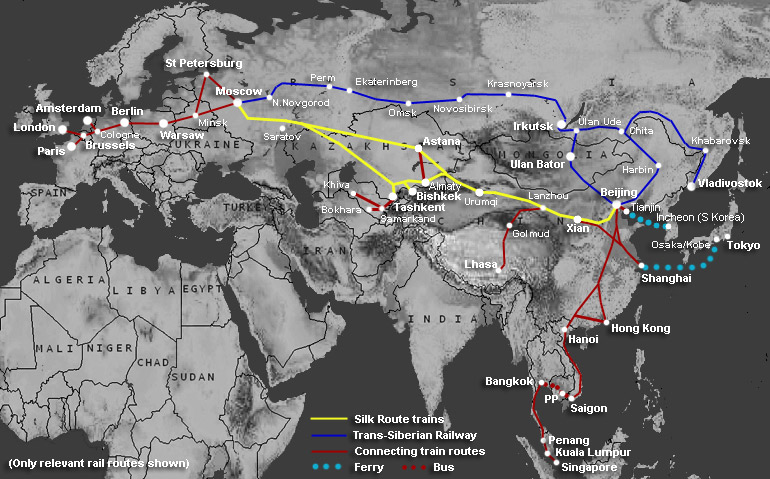
Route map - The Silk Route & Central Asia by trainASTANA in Kazakhstan is one of the world’s most remote capitals, surrounded by thousands of kilometres of empty steppe. This summer Astana attempted to launch itself onto the global stage by hosting the World Expo, which closed on September 10th and underwhelmed many attendees. But there are other ways to have an impact. On the city’s north side, away from the Expo’s exhibits, a series of diesel trains, each pulling dozens of containers, roll through the old railway station. Most are heading from China to Europe. Last year over 500,000 tonnes of freight went by train between the two, up from next to nothing before 2013. Airlines and shipping firms are watching things closely.

The trains rumbling through Astana result from a Chinese initiative, in tandem with countries like Kazakhstan, to build a “New Silk Road” through Central Asia. The earlier overland routes were once the conduits for most trade between Europe and China and India; they faded into irrelevance when European ships started circumnavigating the Cape of Good Hope.

China has long wanted to develop its inland regions and push industry to “go west”, in order to spread economic growth more evenly. Manufacturers have been loth to shift, in part because of the higher cost of moving goods to ports for export. Developing a rail-freight network to Europe—an important part of China’s “One Belt One Road” policy—opens up a new route to market for its poorest areas. The land route through Central Asia is relatively short. A container ship too large for the Suez canal must make a 24,000km journey to reach Europe. Trains travel no more than 11,000km to reach the same destination.

Kazakhstan has spent over 1.1trn tenge ($3.2bn) on upgrading its railway lines and rolling stock since 2011. That includes $250m on the Khorgos Gateway, a dry port at the border with China that lifts containers from Chinese trains onto Kazakh ones to overcome a change in track width (a problem that has stymied previous efforts to build railway routes between Europe and China).

Volumes of freight travelling between China and Europe by rail are rising quickly. Between 2013 and 2016 cargo traffic quintupled in weight. In the first half of this year the value of goods travelling by train rose by 144% compared with the same period in 2016. Western firms have been keen to embrace rail freight because it helps them to lower costs, says Ronald Kleijwegt, an expert on the industry. In the case of high-tech electronics, for example, which consumers like to receive quickly, making them on China’s coast and air-freighting them to Europe is extremely pricey.

How worried should shipping firms and airlines be? Kazakhstan’s national rail company, KTZ, says it will have capacity for 1.7m containers to pass through the country between Europe and China each year by 2020; that is a tenth of the volume currently carried by sea and air between the two. In the longer term, a full modernisation of the existing main three rail routes from China to Europe could produce 3m containers a year in capacity.

But there are also reasons to doubt that will happen. For one thing, China plans to stop handing out government subsidies for additional rail-freight capacity from 2020, which will slow the network’s expansion. Sea freight has little to fear in the near term, says Soren Skou, chief executive of Maersk, the world’s biggest container-shipping line. Trains may take away some future growth from ships, he concedes, but not their existing business.

Air cargo is more vulnerable. Last year, 180,000 tonnes of cargo travelled on trains to western Europe from China (the remainder was destined for Russia and eastern Europe). That is a small fraction of the 52m tonnes that came by sea, but a big chunk of the 700,000 tonnes that came by air. Much of that air cargo could switch to rail in future, says Mr Kleijwegt, with one important proviso—that Russia would need to lift the retaliatory sanctions it placed in 2014 on imports of Western food, which stop most foodstuffs from traveling by land between Europe and China. That is unlikely for the time being. But it was only a decade ago that people thought the idea of freight trains between Europe and China was a joke, says Mr Kleijwegt—and no one laughs at that any more.

Read more: New rail routes between China and Europe will change trade patterns

Saturday, October 22, 2016

China’s wind power industry faces slowdown as tariff cuts loom

Mainland China’s wind farm developers and equipment suppliers face a substantial drop off in installation volume in 2018 when Beijing’s proposed cuts to wind power tariffs are expected to take effect, industry executives warned.

Profitability will also be hampered by further power grid bottlenecks and intensifying competition over price and sales volume amid wider capacity oversupply, they told the China Windpower conference.

“What worries us is [plant] utilisation, which has been falling much more than expected,” said Alvario Bilbao, the Asia Pacific chief executive of Gamesa, one of the world’s largest wind turbine makers.

The Spanish firm has stayed in the China market – the world’s largest - despite its market share dropping to 0.27 per cent in 2014 from 36 per cent a decade earlier due to stiff competition from domestic rivals.

Read more: China’s wind power industry faces slowdown as tariff cuts loom | South China Morning Pos

Thursday, March 17, 2016

Real Estate: Global Market Perspective

US Real Estate Market looking up 
For additional info.on this beautiful  Maine (5 bedroom 
B&B property )write to: real_estate@eclipso.eu 
LL's Global Market Perspective has chronicled the journey of the world’s dominant real estate markets since the depths of the Great Recession in 2008, a journey that has been led throughout by strengthening investment markets as a huge weight of money targets real estate assets.

But, as we move into 2016, the dynamics have started to shift, with the occupational markets now registering greater momentum.

Market fundamentals are improving across all major global regions and property sectors, and recent leasing activity has surprised on the upside. Geopolitical and economic headwinds will weigh on business activity over the coming months, but for now, corporate occupiers remain in growth mode which, combined with tightening supply, will support rental value growth during 2016 in most major markets.​​

Improved consumer confidence and healthy retail sales are fuelling optimism in the U.S., Europe and selectively in Asia Pacific. Several

U.S. markets, primarily gateway cities, are now witnessing conditions typical of a peaking market as rents see assertive growth and vacancy continues to compress. Meanwhile, UK regional markets and Berlin
experienced the strongest rental growth over the year’s final quarter in Europe, while increases were also recorded in the recovery markets of Italy and Spain.

In Asia Pacific the demand picture remains varied, with the acceleration in retail spending in Australia contributing to  leasing demand, although rental growth has been limited in most regional markets over the quarter.

For the complete report click here:  Global Market Perspective | JLL

Monday, March 14, 2016

Global Shipping: Shipping rates hit new lows on excess supply - by Luke Graham

Port Of Rotterdam, the Netherlands
The global shipping industry continues to fall victim to weakening demand and excess supply with freight rates on some routes hitting all-time lows, latest figures show.

Average spot freight rates fell to a record low of $701 per 40-foot shipping container last week, according to the World Container Index (WCI) which tracks 11 global shipping routes. This was the lowest reading since the index started tracking rates in 2011.

The WCI index is 60 percent below the five-year average and has fallen 62 percent in the past year, according to the WCI's director, Richard Heath, in a press release.

One of the worst hit lines is the Asia to Europe route. The Shanghai Containerized Freight Index showed shipping costs on the route have fallen 82 percent over the past 10 weeks to $211 per 20-foot container.

Along with weakening demand from markets such as China, the glut of container ships plying the world's seas has been a major factor hitting freight rates, Philip Damas, director at Drewry, told CNBC in a phone interview. The current rates are not sustainable, he added.

Maersk echoed these reasons in their recent full-year financial reports.

"The continued lack of demand and over-capacity resulted in sharply declining rates from the second quarter and onwards," said Søren Skou, CEO of Maersk Line, in the company's annual report.

Red more: Shipping rates hit new lows on excess supply

Monday, January 11, 2016

Political Mismanagement : 10 Economic, Political and Social Global Forecasts Indicate Troubled Times Ahead In 2016 - by RM

The legacy of a totally failed Middle East Policy
As a wise man once said "Without Freedom Of Speech There Are Only Official Lies"

Below links to 10 reports which indicate that the overall state of our globe in 2016 does not look very rosy.  Click on the headline to get the report.


Change however lies in the hands of the people, and if politicians have made life worse rather than better for you - get rid of them. Don't sit on the sidelines staring at your navel or pointing your finger at others.   

After all : "The health of a democratic society may be measured by the quality of functions performed by its private citizens" - Alexis de Tocqueville

EU-Digest

Tuesday, December 22, 2015

2015 Business Year Review: tracking the global recovery

even years after the crisis began, the global economy has taken decisive steps out of the dark. Just as the collapse hit countries in different ways, the way out has not been the same for everyone. Some countries have made it in high gear, others have been slowly working up through low ones.

But the process is well underway and in this programme we track the recovery with our own correspondents to see how connected the global economy is, and what to expect in 2016.

We start in the country that is now leading the recovery – the United States. The world’s largest economy made its way through the crisis and is now in a period of growth that is hopefully solid enough to stand the higher interest rates recently announced by the Federal Reserve.

That’s not the case in Europe yet. The recovery here is way behind. Eurozone countries don’t always share their advances, but they do share the problems.

We look at the economic fairy-tale in Germany, the eurozone’s largest economy, that’s been damaged by the country’s leading company. We check out the situation in Spain – one of the fastest growing in the block, where the data always look way better in the summer – and examine Greece, where the holiday season was really hot, though not relaxing.

After Europe, we go to Asia, where China became a ticking bomb when Beijing tried to slow down growth.

And finally we analyse parts of the Arab world where the recovery has been hit not only by lower oil prices, but also by terrorism that has taken a high toll on tourism and the wider economy.
 
Read more: Business Year Review: tracking the global recovery | euronews, world news