ANNUAL ADVERTISING RATES FOR INSURE-DIGEST

Annual Advertisement Rates
Showing posts with label Education. Show all posts

Tuesday, November 26, 2019

The Netherlands: Rutte Government under fire over costly healthcare and educational student loan programs - by RM

The Netherlands privatized Healthcare and Educational programs are not proving to be one of  the Dutch PM's Rutte success stories. As a matter of fact, they are both a disaster, too costly and worst of all undemocratic.

It seems that Mr. Rutte and some of his colleages in the Dutch Government don't seem to be aware that education and healthcare, are not, and can never be seen as marketable commodities.

They are a basic democratic right for everyone, poor or rich, and must be free and widely available to all citizens.

The present privatized health and educational programs, applied by the Dutch Government and a few other Governments in the EU, and around the world, are not only undemocratic, they are also proving to be a financial barrier in providing proper education and healthcare to every level of the population, and when all is said and done, actually do not benefit the overall economy.

It is regrettable that some countries, including the Netherlands, have turned these basic human rights, related to education and healthcare, into marketable commodities.

Almere-Digest

Sunday, September 16, 2018

The Netherlands - Free Market Forces in Health-Care and Education not benefitting Netherlands consumers - by RM

After returning back home from America to the Netherlands, it struck me how incredibly passive the Dutch population reacts to many decisions of their Government, which unfortunately, usually negatively affects the "pocketbooks" of the average Dutch citizen.

Particularly, because when these decisions are announced, the  Dutch Government gives little or often no clear explanation, about the nature or reasons for these decisions. Their catch words usually are, either to improve the economy or to cut costs.

One example is the Dutch Health-Care system, which was changed a few years ago from a government controlled Universal Health-Care program, to a "Market controlled version, now mainly controlled by Insurance companies.

According to a recently held opinion poll, however, a majority (more than 60%) of the Dutch population wants to return to the old system of Universal Health-Care, since the new system, now run by Insurance companies has steadily increased their costs for affordable Health-Care .

In the field of education, Dutch students, who used to be able to apply for a free scholarship, which they did not have to pay off, after they successfully had completed their educational program, now have to pay back their scholarship through a loan program, including interest.

Unfortunately, many Dutch politicians, and large companies have abused the concept of "market forces" to create the suggestion of freedom and honesty.

A truly free market offers advantages, but with economic "spins and gibberish", as it does now, it certainly does not.

Bottom - line, the Dutch citizen is now at the mercy of a few large suppliers - and the so-called benefits of the market forces do not end up being tangible economic benefits to them .

The Netherlands economy, unfortunately,  is starting to look more and more like that of the US, and that certainly is a scary idea. 

Isn't it time to man the barricades?

C: this article can be published if source is identified as EU-Figest

EU-Digest

Saturday, August 25, 2018

USA: Politics in America are Corporate, not Citizen focused - Why are guns a right in the US, meanwhile education and healthcare are not?

USA: Corporate Insurance Policies suck
The fact that the US isn’t among the countries with universal healthcare and free college has been a topic of many heated political debates and complaints, especially among the Millennials faced with the prospect of repaying their student loans well into their adulthood. If they have a misfortune of getting hit with a major hospital bill as well, declaring a bankruptcy is often the only solution.

Universal healthcare is something that is available in a vast number of countries across the globe. While the programs offered by each government varies from nation to nation, they’re all based on the same concept – offering access to free healthcare to everyone, old or young. Most often than not, insurance is offered freely for the underaged and the elderly, while those in the working force have a small portion of their paycheck directed to the national fund sustaining this system.

Free education is something that is widely encountered across the globe, although college isn’t always included on the list. Many countries offer a number of free university seats while others subsidize them.

Many argue that this type of education, just like universal healthcare, isn’t actually free since it is funded by the government, who in turn gathers the cash by taxing people’s paychecks and businesses. 

Basically that is an argument used in the US which in reality does not fly, because the end result in countries which do provide this service  is offering everyone access to what they need, be it education that will provide them with a better future without having to spend half of their lives paying back the student loans or getting the healthcare they need.

Across the globe, there are quite a lot of countries that offer free healthcare, from the Americas, Asia, although the most are from Europe where this seems to be the way to go when it comes to this important issue.

Many European (EU)  countries regard free education also as an investment to the economy. There is skilled workforce available on the free labor market. The opposite solution could be for example that every industry would educate their own work force starting from day one.

Capitalism or socialism doesn’t define who must pay the education: the society, the industry or the individual.

It’s the same with the healthcare: there isn’t any rule that tells that either the society, the employer or the individual should be the one who pays for the health care. It could be also so that every industry should build their own hospitals and educate their own doctors - or so that the people, the work force, do it together. But it can also be regarded as a state’s investment in the economy so that the free work force remains available and capable on the market.


These investments by the state are comparable with other investments in the infrastructure and the functionality of the society. The state offers some base for the free economy to thrive, like roads, security and so on.

Socialism is so abused and so polymorphic concept that it’s hard to define simply. But in the basic concept of socialism is about how the economic power is divided between the capital and the labor.

It certainly has nothing to do with communism, which unfortunately many right-wing conservatives like to call socialism.
.
The ultimate goal is a society that has stopped the domination of capital over the labor and where the labor has taken the domination on the production. This doesn’t necessarily mean that the state should own everything.

Both of these functions can also be shared in different ways as long as it benefits the citizens and the country as a whole.

In America the concept has become totally lopsided over the years. Today about 3 % of the US population controls all the wealth in the country, with corporations basically influencing all the decision making processes of the political establishment.

If not corrected soon, it will have disastrous consequences for America.

EU-Digest

Wednesday, July 19, 2017

USA: Have and have not's: There's a large group of Americans missing out on the American dream

There’s a growing tendency for mainstream economists, including several of those at the Federal Reserve, to dismiss all income disparities as the product of a skills- or education gap, a misleading explanation given weak wage growth that points to ongoing weakness in the job market. 
\
So it was relieving to see, tucked in the US central bank’s latest semi-annual report to Congress on monetary policy, an analysis of recent inequality research that refutes the idea that education is the only factor behind income inequality. Race, unsurprisingly, also plays a major role, as do social and economic measures, including taxation, interest rates, and labor policies. The Fed states:

“The persistent gaps in economic outcomes by race and ethnicity in the United States raise important questions about how people ascend the economic ladder. Education, particularly a college degree, is often seen as a path to improved economic opportunities.
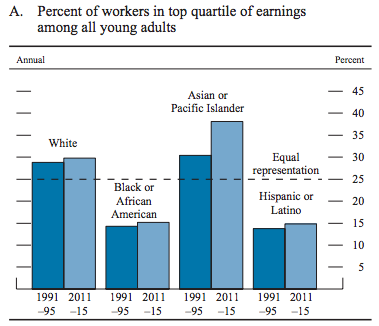
“However, while education continues to be an important determinant of whether one can climb the economic ladder, sizable differences in economic outcomes across race and ethnicity remain even after controlling for educational attainment. Data on earnings for two cohorts of young adult workers (aged 25 to 34) approximately a generation apart confirm both the gaps in economic outcomes and the lack of substantial upward progress for disadvantaged groups over the past quarter-century.”

FeducationA
Foto: source Federal Reserve 
“Overall, the representation of black and Hispanic workers in the top earnings quartile continues to lag in the later period,” the report adds.

For the complete detailed report click here: There's a large group of Americans missing out on the American dream

Tuesday, July 11, 2017

EU Educational Sector: 80% of graduates in the field of education are women

Almost 5 million tertiary education students graduated in the European Union (EU) in 2015: 58% were women and 42% men.

Male dominated fields are 'Information and Communication Technologies' (where men account for 81% of the graduates) and 'Engineering, manufacturing and construction' (73%).

On the other hand, four out of five graduates in 'Education' are women (80%). Another field where women are largely over-represented is 'Health and welfare', with 74% female graduates.

One in four graduates studied 'Business, administration and law'

The largest share of graduates in the EU studied 'Business, administration and law' (24%). This was the most popular field in all Member States except for Belgium, Denmark, Sweden and Finland, where the largest share of graduates were in 'Health and welfare', and Portugal, where the most popular field was 'Engineering, manufacturing and construction'.

'Business, administration and law' was particularly popular in Luxembourg, with 39% of all graduates. It accounted for a large share also in Cyprus (35%), Bulgaria and France (both 34%).

One in five graduates in Germany (22%), Portugal (21%) and Austria (20%) received their diplomas in 'Engineering, manufacturing and construction'.

The share of graduates in 'Health and welfare' was the highest in Belgium (26%), where one in four graduated in this field. 22% of graduates in Sweden and Denmark studied this subject.

'Arts and humanities' were a popular field in the United Kingdom and Italy (both 16%).

16% of the graduates in Bulgaria followed the 'Social sciences, journalism and information' programme.

The largest share of 'Education' graduates was in Cyprus (18%).

With 13%, the United Kingdom had the highest share of 'Natural sciences, mathematics and statistics' graduates.

Read more: 80% of graduates in the field of education are women - Product - Eurostat

Wednesday, May 3, 2017

Europe's Economic Power House: Why Germany Still Has So Many Middle-Class Manufacturing Jobs - by Hermann Simon

Germany:  The EU's Number One Economic Powerhouse
Only about 1.1% of the world population is German. However, 48% of the mid-sized world market leaders come from Germany.

These firms, which I call “Hidden Champions,” are part of what makes German economic growth more inclusive: by my calculations, they have created 1.5 million new jobs; have grown by 10% per year on average; and register five times as many patents per employee as large corporations. And they are But the reasons they are a predominantly German phenomenon are many.

This includes the German history of many small independent states (until 1918 Germany consisted of 23 monarchies and three republics), which forced entrepreneurs to internationalize early on in a company’s development if they wanted to keep growing. In addition, there are traditional regional crafts, such as the clock-making industry in the Black Forest with its highly developed fine mechanical competencies, which developed into 450 medical technology companies, most of them makers of surgical instruments.: my estimate is that in the last 25 years no more than 10% of them disappeared or were taken over, a distinctly lower percentage than for large corporations. Nearly all of them survived the great recession of 2008-2009.

Moreover, Hidden Champions have also contributed to the sustainment of the German manufacturing base, and it is in large part thanks to them that nearly a quarter of the German gross domestic product continues to come from manufacturing. The percentage in most other highly industrialized countries such as the U.S., the UK, or France is only about half of this. The effect on employment is enormous. Manufacturing creates jobs at home and at the time same allows companies, through exports, to participate in the growth of emerging countries.

Given this success, it’s not surprising that many non-German policymakers and economists have looked to the Hidden Champions, or more broadly, the Mittelstand, to try and chart a path to more inclusive growth in their own countries. But how replicable is their success? While other countries could try to emulate aspects of what makes the Hidden Champions so successful, the reasons for their success are the result of a complex network of factors, many of them historical.

A Hidden Champion is defined by three criteria: 1) a company has to be among the top three in the world in its industry, and first on its continent; 2) its revenue must be below €5 billion; and 3) it should be little known to the general public. Germany seems exceptionally good at creating these companies; I have identified 2,734 Hidden Champions worldwide and no less than 1,307 of them are based in Germany. You might argue that my research is deeper in Germany than in other countries, and most likely I wouldn’t be able to prove you wrong. But researchers in other countries have also examined this phenomenon and found far fewer Hidden Champions in their countries. A colleague who looked for Hidden Champions in Japan for years identified only 220 companies, a researcher in France has come up with only 100. With the exception of Switzerland and Austria, the per capita number of Hidden Champions is nowhere near as high as it is in Germany.

Of course, success of individual Hidden Champions is based on their leadership and strategy. The most important difference is the continuity of the leadership. The leaders of the Hidden Champions stay at the helm for an average of 20 years; according to Strategy&, which collects data on the world’s largest 2,500 companies, in large firms the average CEO tenure from 2012 – 2016 was only seven years, and the median was even shorter, at five and a half years. The leaders of Hidden Champions are also more likely to come into power at a young age and are more often women than in larger companies.

But the reasons they are a predominantly German phenomenon are many. This includes the German history of many small independent states (until 1918 Germany consisted of 23 monarchies and three republics), which forced entrepreneurs to internationalize early on in a company’s development if they wanted to keep growing. In addition, there are traditional regional crafts, such as the clock-making industry in the Black Forest with its highly developed fine mechanical competencies, which developed into 450 medical technology companies, most of them makers of surgical instruments.

Scientific competencies also play an important role. The cluster of 39 measurement technology companies in the area of the old university of town of Göttingen are the result of the leading role Göttingen university’s mathematics faculty had for centuries. The Fraunhofer Institute continues to function as a transmission belt between science and practical applications. The Munich-based Hidden Champion Arri, world market leader in professional film cameras, used the expertise of Fraunhofer to navigate the transition from analog to digital technology, and was thus able to defend its leading market position.

A further pillar of the Hidden Champions’ competitive strength is the unique German dual system of apprenticeship, which combines practical and theoretical training in non-academic trades. The Hidden Champions invest 50% more in vocational training than the average German company.

Tax advantages are another reason. The high taxes on assets in France and the inheritance tax in the U.S. prevent the accumulation of capital necessary for the formation of a strong mid-sized sector.

Finally, the international openness of a society is an essential factor in the globalized world of the future.

Germany is far ahead of other large countries with regard to mental internationalization. This includes language competencies, international experience from student exchanges, and university studies. Countries such as France, Italy, Japan, and Korea lag far behind in these respects.
Why is this mental internationalization so important? Because while Hidden Champions may be small, they compete on a global scale.

They achieve world-class quality by keeping their focus narrow; focus is the most important element of a Hidden Champion’s strategy. Flexi, for example, makes only one product — retractable dog leashes — but has the claim to make them better than anyone else. This has allowed them to reach 70% of market share in this category. But focus makes a market small. How can you make it bigger? By globalizing. Today, the Hidden Champions are present in their target markets with 30 subsidiaries on average. Despite their medium or small size, they are true global players. About one quarter of German exports comes from the Hidden Champions.

Read more: Why Germany Still Has So Many Middle-Class Manufacturing Jobs